A Perfect 3-Day Sedona Itinerary for First-Time Visitors
We have watched a lot of first-time Sedona plans go sideways, and they almost always fail in the same two ways: they cram four hikes into a day that only has room for one, and they schedule the marquee trails for mid-morning, when the lots are full and the slickrock is already baking. Sedona rewards the opposite approach. Hike at first light, when the rock is cool and the parking is yours. Tour or taste in the heat of the day. Keep your evenings loose for a sunset that will stop the conversation and a dinner you did not have to rush to.
This three-day plan is built for couples and small groups seeing Sedona for the first time, and it is the plan we hand our own friends. It front-loads the hard, popular hikes to early morning, parks the crowds and heat in the afternoon, and leaves each day with a little slack so you are not sprinting between red rocks. Times, food stops, and seasonal swaps are baked in. Follow it loosely and you will leave already planning the second trip.
The Short Answer Three days is enough to see Sedona’s highlights if you hike in the mornings and keep afternoons flexible. Day 1: arrive, get oriented on the Red Rock Scenic Byway, watch the sunset from Airport Mesa, then eat in Uptown or Tlaquepaque. Day 2: a sunrise hike at Cathedral Rock (or Devil’s Bridge), a midday jeep tour, and Verde Valley wine in the afternoon. Day 3: an easy Oak Creek Canyon morning at West Fork or Slide Rock before you drive home. Start hikes at or before sunrise to beat the heat and full parking lots.
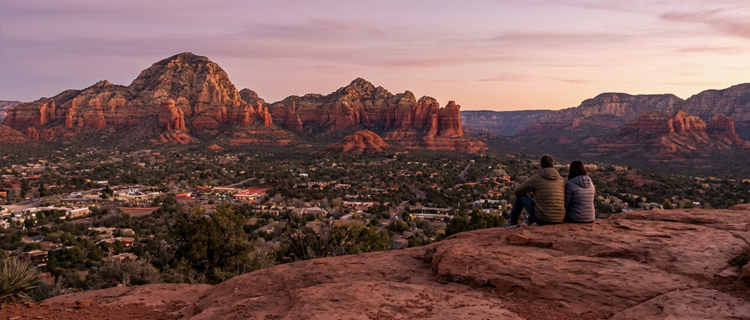
The Airport Mesa overlook at sunset: an easy first-evening stop with the whole town and the red rocks laid out below.
The 3 days at a glance
Here is the whole plan in one view. The logic is simple: the physically demanding, parking-limited hikes happen at sunrise, the in-a-vehicle or sit-down activities fill the hot middle of the day, and evenings stay open for a view and a meal. Adjust the exact clock by season (see the timing section below), but keep the sequence.
Day
Morning (early)
Midday / afternoon
Evening
Day 1: Arrival
Travel in, hotel or rental check-in, light orientation drive on SR-179
Uptown stroll, easy scenic stop (Bell Rock or Chapel of the Holy Cross)
Airport Mesa sunset, then dinner in Uptown or Tlaquepaque
Day 2: Signature day
Sunrise hike: Cathedral Rock (short, steep) or Devil’s Bridge (the arch)
Midday jeep or off-road tour, then Verde Valley or Page Springs wine
Relaxed dinner, early night before Day 3
Day 3: Oak Creek
Easy creek morning: West Fork Trail or Slide Rock State Park
Late breakfast or brunch, last Uptown browse
Drive home (or add a fourth day)
Trailhead and parking conditions change with weather, wildfire, and post-fire flooding. Confirm current closures before each morning (see the Day 3 note and the linked forest and park sources).
Day 1: Arrive, orient, and the Airport Mesa sunset
Keep the first day low-effort. You are likely arriving from Phoenix (about two hours) or Flagstaff (about 45 minutes), so treat Day 1 as orientation, not a hiking day. Check in, drop your bags, and let Sedona introduce itself.
Orient yourself on the Red Rock Scenic Byway
Drive south on State Route 179, the Red Rock Scenic Byway, which threads past Bell Rock, Courthouse Butte, and the turnoff to the Chapel of the Holy Cross. Pull off at a viewpoint or two, walk the flat first stretch of the Bell Rock Pathway if you want to stretch your legs, and get a feel for how the town sits inside the rocks. This is also the drive that tells you which formations you want to hike tomorrow.
Browse Uptown and Tlaquepaque
Head into Uptown Sedona, the walkable strip of shops, galleries, and patios along SR-89A, then cross to Tlaquepaque Arts & Shopping Village, the Spanish-style courtyard complex on SR-179. The village’s shops and galleries generally run 10 a.m. to 5 p.m. Monday through Thursday and until 6 p.m. Friday through Sunday, and its restaurants keep later evening hours than the retail tenants. Confirm current hours on the Tlaquepaque hours page before you plan dinner around it.
Catch the sunset from Airport Mesa
Airport Mesa is the classic first-night sunset because it is easy to reach and delivers a wide view over the whole red-rock basin. You have two options: the tiny free lot at the saddle (a short, steep vortex knoll climbs from there) or the paid Airport Vista overlook a little higher up the road. Both fill early. Arrive 45 to 60 minutes before sunset to get parking and a spot on the rocks. Sunset lands around 7:30 p.m. in midsummer and closer to 5:20 p.m. in December, so check the day’s exact time and work backward. Afterward, dinner in Uptown or at one of Tlaquepaque’s restaurants is a five to ten minute drive away.
Day 2: Sunrise hike, midday jeep tour, afternoon wine
This is the big day, and its whole design is to get the hard, crowded hike done before the sun and the crowds arrive, then shift to activities that are pleasant in the heat. Set an alarm. A sunrise start is the single best decision you will make on this trip.
Sunrise: Cathedral Rock or Devil’s Bridge
Pick one signature hike and do it at first light. Cathedral Rock is the more reliable choice for most first-timers: it is only about 1.2 miles round trip, but it climbs a steep slickrock chute (roughly 600 to 700 feet of gain) to a saddle view that many consider Sedona’s finest. The Back O’ Beyond Road lot is small and fills by mid-morning, so ride the free Sedona Shuttle (Route 15) instead of gambling on parking. Devil’s Bridge, Sedona’s largest sandstone arch, is the other icon; how you reach it depends on your vehicle, since the direct Dry Creek trailhead needs high-clearance four-wheel drive and the walk-in routes run roughly 4 miles round trip from the Mescal or Dry Creek Vista lots. Either way, be on the trail by sunrise. Confirm current routes and days with the Sedona Shuttle, since trailhead routes typically run Thursday through Sunday and can be suspended during closures.
Parking reality The lots for Cathedral Rock and Devil’s Bridge routinely fill within an hour or two of sunrise in high season. The shuttle exists precisely because of this. If you would rather drive, be parked before first light and carry a Red Rock Pass (about $5 per day), or a federal America the Beautiful pass, where it is required.
Midday: a jeep or off-road tour
By late morning the trails are hot and busy, which is the perfect time to get off your feet and into a vehicle someone else is driving. A guided off-road tour is the Sedona activity that works best in the middle of the day: you cover dramatic terrain you cannot reach in a rental car, and a guide handles the driving and the history. Established operators like Pink Jeep Tours run several routes from Uptown, and the Broken Arrow tour to Chicken Point is the long-running favorite. Book a day or two ahead in peak season. Most tours run 1.5 to 3 hours, so you will still have your afternoon.
Afternoon: Verde Valley and Page Springs wine
Sedona sits at the edge of Arizona wine country, and the Verde Valley is an easy afternoon pivot. Page Springs Cellars in Cornville is about a 35 to 45 minute drive southwest and has a creekside tasting room open daily (Sunday through Wednesday 11 a.m. to 6 p.m., Thursday through Saturday 11 a.m. to 8 p.m.). Nearby Alcantara Vineyards and the cluster of tasting rooms in Cottonwood’s Old Town round out the scene. Pick a designated driver or book a wine tour van, and confirm hours and any reservation policy on the wineries’ own sites before you go. Prefer to stay closer? Tlaquepaque and Uptown both have tasting rooms if you would rather not drive out.
Day 3: An easy Oak Creek morning
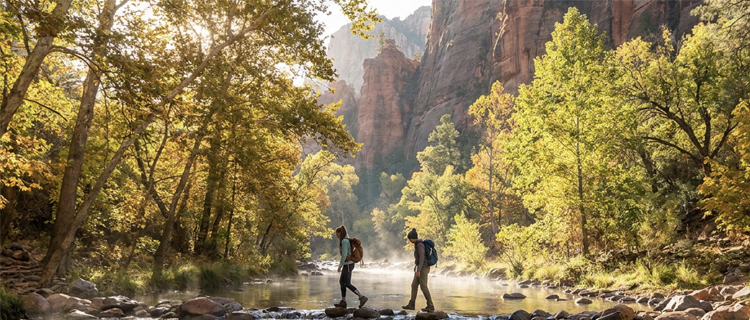
An Oak Creek morning: cool canyon air, creek crossings, and cottonwoods that turn gold in fall. Day 3 is built for this slower pace.
Keep the last day gentle and creek-focused, then point the car home. Oak Creek Canyon, the tree-shaded gorge that carries SR-89A north toward Flagstaff, is a cooler, greener counterpoint to the exposed red-rock trails, and it is the right note to end on before a drive. Two classic stops anchor this morning.
West Fork Trail
The West Fork Trail is Sedona’s most beloved shaded hike, following the West Fork of Oak Creek up a narrow canyon with 13 stepping-stone creek crossings over a roughly 3-mile-each-way maintained section. It is easy in grade, gorgeous, and the premier fall-color walk in the area (cottonwoods and maples usually turn gold from mid-October into early November). West Fork sits inside the Call of the Canyon day-use area and charges its own day-use fee, separate from the Red Rock Pass, so verify the current fee and hours.
Slide Rock State Park
Slide Rock State Park is the natural rock water slide in Oak Creek, best on a warm morning before the day-use lot fills. As of 2026, the park runs 8 a.m. to 6 p.m. from late January into late November (last entry and swim access close an hour before), with a shorter 9 a.m. to 5 p.m. window in deep winter. Day-use entry is per vehicle and seasonal: about $30 from May through September and $20 from October through April. Go right at opening on a summer day, since the lot caps out and closes to new cars when it is full. Check current hours and fees with Arizona State Parks.
Check status before Day 3 Summer 2026’s Pocket Fire left a burn scar north of Sedona, and post-fire flooding and debris flows can close the Call of the Canyon / West Fork day-use area, creek access along Oak Creek, and Slide Rock’s water access on short notice, especially during monsoon season. SR-89A and the rest of Sedona are unaffected. Confirm the day’s status with the Coconino National Forest alerts page and Arizona State Parks the night before. If the canyon is closed, swap in an easy red-rock morning instead, like the flat Bell Rock and Courthouse Butte Loop in the Village of Oak Creek or a return to the Chapel of the Holy Cross.
Whichever you choose, keep it to a half day. Grab a late breakfast or brunch back in town, do one last Uptown browse, and leave with time to spare rather than rushing a checkout after a full hike.
Seasonal timing and pacing tradeoffs
The sequence above holds in every season, but the clock and a couple of swaps change with the calendar. The constant is this: the hotter the forecast, the earlier your hikes have to start.
Season
Hike start
What to adjust
Summer (Jun to Aug)
At or before sunrise, no exceptions
Trails top 100 degrees by late morning. Do Cathedral Rock or Devil’s Bridge first thing, then jeep and wine indoors or in shade. Slide Rock’s creek is a highlight now.
Spring & fall (Mar to May, Sep to Nov)
Early morning, more forgiving
The mildest, most comfortable windows. Fall adds West Fork’s color; spring adds green and wildflowers. These are the easiest seasons to keep the plan relaxed.
Winter (Dec to Feb)
Mid-morning is fine; sunset is early
Cool, quiet, and often clear. Shift Airport Mesa sunset to around 5:20 p.m., lean into Oak Creek Canyon scenery, and expect occasional snow dusting the rocks. Some higher trails can be icy.
Spring and fall are the mildest, least crowded seasons overall, which is one reason spring is often the best time to visit Sedona. In summer the whole plan lives or dies on that sunrise start. In winter you trade heat for short daylight, so front-load the sightseeing and enjoy how empty the trails are.
If you have a fourth day
Three days covers Sedona itself. A fourth day is best spent radiating out, because the region’s day trips are genuinely worth it. The Grand Canyon South Rim is about two hours north and doable in a long day. Jerome, the historic hillside mining town, and the Verde Valley wineries are both around 45 minutes away. Flagstaff, with Route 66, Lowell Observatory, and a strong brewery scene, is roughly 45 minutes up Oak Creek Canyon on SR-89A (check that the canyon corridor is open before you count on that route). Save the far drive for a day when you are not also trying to squeeze in a Sedona hike.
Where to base so early starts are easy
The whole itinerary rests on being able to reach a trailhead at sunrise without a long, sleepy drive. Basing centrally in West Sedona or the Village of Oak Creek puts you within a short drive of the shuttle park-and-ride lots and most major trailheads, so a 5:30 a.m. alarm actually turns into boots on the trail. A private home also gives a couple or a small group somewhere to spread out, cook a fast pre-hike breakfast, and soak tired legs in a hot tub after Cathedral Rock. StayPorter’s Sedona vacation homes and Sedona villas suit first-timers who want space and a kitchen over a hotel room, and longer stays can look at weekly Sedona rentals to spread the plan across more mornings.
One last thing before you go
Here is what three days in Sedona actually feels like when the plan works. You are on the Cathedral Rock saddle at 6:40 in the morning with the whole basin turning pink and maybe six other people, and you understand, all at once, why people get a little evangelical about this place. By lunch you are bouncing over slickrock in the back of a jeep laughing at how much your quads already hurt. By four you are on a creekside patio with a glass of Arizona red you did not know existed. And that night you are back at the house with the hot tub going, comparing photos, already arguing about which hike to do next time.
The house is the part people underrate. Every early start in this plan is easy when the trailhead is fifteen minutes away and the coffee is already brewing, and every big day lands softer when there is a kitchen, a couch, and a soak waiting at the end of it. StayPorter’s Sedona homes are set up for exactly this kind of trip, in exactly the neighborhoods this itinerary depends on. Pick one, set the alarm, and go meet the red rocks at sunrise. We will have the place ready.
Book the base that makes the early starts easy. A centrally located Sedona home puts you minutes from the trailheads and the shuttle lots, with a kitchen for the pre-hike breakfast and a hot tub for the legs afterward.
Yes, three days is enough to see Sedona’s highlights as a first-timer. It gives you one signature hike, a jeep or off-road tour, a sunset at Airport Mesa, an easy Oak Creek Canyon morning, and time for food and browsing, without overpacking any single day. The key is hiking in the mornings and keeping afternoons flexible. If you also want a Grand Canyon or Jerome day trip, add a fourth day rather than cutting Sedona itself short.
What is the best day and time to hike Cathedral Rock?
Hike Cathedral Rock at sunrise on whichever morning your schedule allows, ideally early in your trip so you have a weather backup. The trailhead lot on Back O’ Beyond Road is tiny and fills by mid-morning, so take the free Sedona Shuttle (Route 15), which typically runs Thursday through Sunday. A first-light start means cool slickrock, open parking, and the saddle mostly to yourself. It is short, about 1.2 miles round trip, but a steep scramble, so wear grippy shoes.
Do you need a jeep tour in Sedona?
You do not need one, but a guided off-road tour is one of Sedona’s best midday activities and reaches terrain you cannot drive to in a rental car. It is especially worth it on a first trip and in hot weather, since a guide handles the driving while you are off your feet during the hottest hours. Operators like Pink Jeep Tours run several routes from Uptown, with the Broken Arrow trail the long-running favorite. Book a day or two ahead in peak season.
When should you do West Fork Trail?
Do West Fork on an easy morning, and ideally in fall for the color, when cottonwoods and maples turn gold from mid-October into early November. It is a shaded, gentle canyon walk with 13 creek crossings, so it works as a relaxed final-day hike before you drive home. West Fork sits in the Call of the Canyon day-use area and charges its own fee separate from the Red Rock Pass. Check current fees, hours, and any closures first, since Oak Creek Canyon can close after wildfire or flooding.
How early do you have to start hikes in Sedona?
In spring, summer, and early fall, start at or before sunrise. Two things drive this: the exposed red-rock trails heat up fast (summer regularly tops 100 degrees by late morning), and the small trailhead lots for Cathedral Rock and Devil’s Bridge fill within an hour or two of first light. An early start solves both the heat and the parking. In winter you have more leeway and can start mid-morning, but daylight is short, so plan sightseeing accordingly.
Is the Airport Mesa sunset worth it, and how early should you arrive?
Yes, Airport Mesa is the easiest high-impact sunset in Sedona and a perfect first-night activity, with a wide view over the red-rock basin. Arrive 45 to 60 minutes before sunset, because the small free saddle lot and the paid Airport Vista overlook both fill early. Sunset falls around 7:30 p.m. in midsummer and near 5:20 p.m. in December, so check the day’s exact time and work backward. Bring a layer, since it cools quickly once the sun drops.
Do you need a car for a 3-day Sedona trip?
Yes. Sedona has no meaningful public transit between its spread-out areas, and this itinerary involves driving to trailhead park-and-ride lots, Oak Creek Canyon, and the Verde Valley wineries. The free Sedona Shuttle covers a handful of the busiest trailheads, but you still need a car to reach it and to get everywhere else. Plan on driving, and factor a Red Rock Pass (about $5 per day) for parking where it is required.
Between Checkout and Check-In: A Day in the Life of Your Home
Short answer: Between a 10 a.m. checkout and a 4 p.m. check-in, a managed home gets a complete professional reset: codes rotate, an inspector walks every room before cleaning, a hotel-standard clean runs to a non-negotiable checklist, beds get fresh hotel-grade linens, essentials are restocked, staging returns to photograph-perfect, and a final check signs the home off. Around that day run weekly, monthly, and seasonal care rhythms plus quiet guardianship (smart locks, noise monitoring, a No Parties Policy). Your home is not being used up; it is being professionally kept.
The most reassuring thing we can do is open the curtain
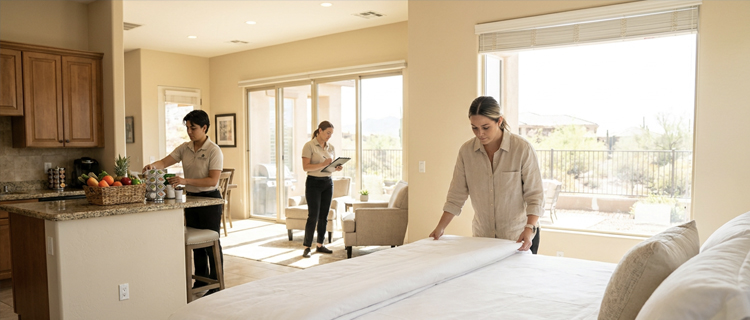
One turnover, start to finish: checkout, inspection, a hotel-standard clean, restocking, and the next guests arriving to a reset home.
When owners imagine handing over the keys, the picture in their head is usually a question mark: what actually happens to my home between guests? Who goes in, what do they do, and how does the place stay so nice through dozens of stays a year? We hear it on almost every first call, and we love the question, because the answer deserves better than reassurances. It deserves a schedule.
So here is a single, ordinary turnover day, opened up hour by hour: one set of guests leaving at ten, the next arriving at four, and everything that happens in between. It is the day your home would live again and again under Porter’s care, and we think seeing it plainly is the most convincing thing we can show you. Most owners finish this page feeling something they did not expect to feel about renting out their home: relief.
Ten to four: the day itself
At ten, the departing guests leave and the smart lock quietly retires their code. Minutes later, an inspector walks every room, before cleaning starts, logging the home’s condition while it can still tell the story of the stay. Then the hospitality clean begins: not a tidy-up, but a hotel-standard reset run to a checklist that does not negotiate. Beds are stripped and remade with fresh hotel-grade linens. The essentials are restocked as a discipline, not a memory. The staging reset returns every cushion, remote, and patio chair to photograph-perfect. A final check confirms the clean, the temperature, and the welcome touch, and at four the new code goes live on a home that looks like it has never hosted anyone at all. Slide through it below.
A Day in the Life of Your Home
From the 10 a.m. checkout to the 4 p.m. check-in: slide through everything that happens between guests.
The full turnover day is below, hour by hour, along with the weekly, monthly, and seasonal care rhythm. Enable JavaScript to slide through the day interactively.
Checkout and the smart lock resets
The departing guests leave; access codes rotate automatically and the home secures itself.
10:00 · Checkout and the smart lock resets
The departing guests leave; access codes rotate automatically and the home secures itself.
10:20 · The inspection walk
A trained eye walks every room: condition, function, anything that needs attention gets logged before cleaning begins.
11:00 · The hospitality clean begins
Not a tidy-up: a hotel-standard clean, room by room, to a checklist that does not negotiate.
12:30 · Linens and laundry
Every bed stripped and remade with fresh hotel-grade linens; towels replaced in generous supply.
13:30 · Restocking the essentials
Coffee, soaps, paper goods, kitchen basics: the quiet generosity guests notice, replenished as a discipline.
14:30 · The staging reset
Cushions, throws, remotes, patio chairs: the home returns to photograph-perfect, exactly as the listing promised.
15:30 · The final check
A last pass confirms the clean, the staging, the temperature, and the welcome touch, and the home is signed off.
16:00 · Check-in: the code goes live
New guests walk into a home that looks like the first day it ever hosted. The story starts again.
Zoom out: the care rhythm around every stay
Every stayHospitality clean, inspection walk, restock, staging reset, linen service
WeeklyGrounds and patio care, pool and hot tub service where fitted, supply audits
MonthlyPreventive walk: HVAC filters, batteries, seals, small fixes caught small
SeasonallyDesert monsoon prep and pool-heater readiness; high-country winterization and snow-readiness
A representative turnover day; exact timing flexes with each home and stay. The point is the standard: your home is professionally reset, dozens of times a year, to the condition the listing promises.
The rhythm beyond the day
Restock, inspect, reset: the same crew and the same checklist every turnover, so the standard never drifts between stays.
The turnover day is the heartbeat, but the care runs on longer rhythms too. Weekly, the grounds, pool, and hot tub get their service, and supplies are audited before they run thin. Monthly, a preventive walk checks the quiet things that fail loudly later: filters, batteries, seals, the drip under the sink that costs nothing today and plenty next year. Seasonally, the home is prepared for what Arizona sends: monsoon readiness and pool-heater prep in the desert, winterization and snow-readiness in the high country, a rhythm we map fully in the home-care calendar.
And woven through all of it runs the quiet guardianship layer: smart locks that rotate codes with every stay, noise monitoring that flags a problem before the neighbors ever could, and a No Parties Policy with a local team behind it. Not because trouble is expected, but because watchfulness is what professional care means, the same standard that powers the five-star stays guests write home about.
This is what “full service” actually contains, and it is why owners who see it tend to relax: the home is not being used up, it is being professionally kept, dozens of times a year, by a local team whose whole job is its condition. It is the operational heart of partnering with Porter, and it comes with every home in the owner program.
If you have been holding back from renting your home because you could not picture who would be looking after it, we hope this page answered the question. The people on that ten-to-four schedule are real, they are local, and they treat your home like the standard it was listed at is a promise. Let us show you exactly how that day would run in your house. Get a free income estimate and a walkthrough of our care rhythm, or call our Arizona team at 866-468-2531 and ask us anything. The curtain stays open.
Frequently asked questions
What happens between guests at a managed vacation rental?
A complete professional reset. After checkout, the smart lock rotates codes and an inspector walks every room before cleaning begins. Then comes a hotel-standard clean, fresh hotel-grade linens on every bed, restocking of the essentials, a staging reset that returns the home to photograph-perfect, and a final check of the clean, temperature, and welcome details, all before the next check-in code goes live.
Why does the inspection happen before the cleaning?
Because the home tells the story of the stay best before anything is touched. Walking the rooms first lets the inspector log condition, spot anything needing attention, and route maintenance immediately, so small things are caught small. It is one of the quiet disciplines that separates professional turnovers from a cleaning crew with a key.
How is a hospitality clean different from a regular clean?
It runs to a hotel-standard checklist that does not negotiate: every room, every surface, to the same bar every time, with beds triple-sheeted in hotel-grade linens and towels replaced in generous supply. The goal is not tidy; it is indistinguishable from the listing photos. Consistency is the point, on the fortieth turnover exactly as on the first.
Who is watching the home during stays?
A quiet guardianship layer runs throughout: smart locks that rotate access codes with every stay, noise monitoring that flags an issue before the neighbors could, a No Parties Policy, and a local team able to respond. It is watchfulness rather than worry, and it protects the home, the neighborhood relationships, and the guest experience all at once.
What care happens beyond turnover days?
Weekly, the grounds, pool, and hot tub get serviced and supplies are audited. Monthly, a preventive walk checks filters, batteries, seals, and the small things that fail loudly later. Seasonally, the home is prepared for Arizona’s calendar: monsoon readiness and pool-heater prep in the desert, winterization and snow-readiness in the high country.
Does all this care really keep a rental in good shape?
It tends to keep a hosted home in better shape than an empty one, because it is inspected, cleaned, and serviced dozens of times a year, with problems caught at the size of a note rather than a repair. Owners are often surprised to find their home better kept under management than it was before, and the turnover rhythm on this page is why.
See the care your home would get
Get a free, no-obligation income estimate and a walkthrough of exactly how Porter would run, keep, and protect your home, stay after stay.
The Team Behind Your Home: Why Porter’s Culture Is Your Competitive Edge
Owners tend to choose a vacation rental manager on the strength of a pitch: the fee, the tech, the
promised revenue. Those things matter. The thing that actually determines how your home performs, though,
is quieter and harder to see on a sales call. It is the team, and the culture that produced it.
Software does not answer a guest at midnight, notice a maintenance issue before it becomes expensive, or
price your calendar with judgment. People do. Porter has built its business around that truth, treating
culture and talent as the engine that drives everything downstream, from guest reviews to your revenue and
the long-term care of your asset. Here is why that focus is your competitive edge, and how to see it for
yourself.
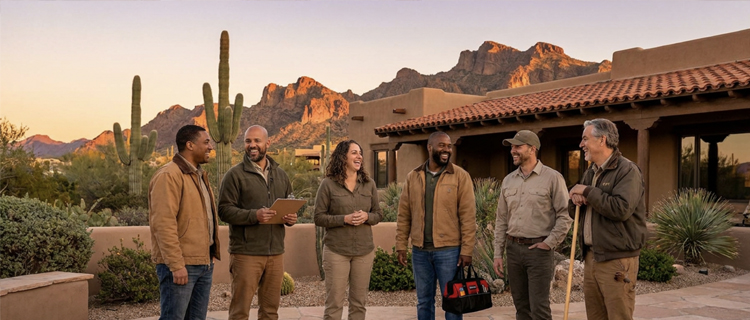
The people behind the pitch: culture is what attracts the team that ultimately runs your home.
Why the team matters more than the pitch
Every part of a vacation rental business that owners care about is delivered by a person. A guest decides
whether to rebook based on how the team made them feel. A small repair stays small because someone caught it
on a turnover. Your rate is right for a big event weekend because a revenue manager made a judgment call the
software would have missed. A prospective guest becomes a confirmed booking because a sales agent answered
well and fast.
That is why the quality of a manager’s people is not a soft factor. It is the factor. A polished pitch
with a thin, overstretched team behind it will underperform a strong team every time, because the team is
what shows up after you sign.
Culture is the catalyst that attracts talent
Good people have choices about where they work. They gravitate toward organizations with high standards,
a real brand, and a reason to be proud of the work. Porter has leaned into exactly that. The company states
its promise plainly: “We Care About YOU First and Foremost” and “We Work for YOU, Not for the
Profit,” built on communication, honesty, and transparency, and a habit of treating customers as
friends.
That is not just guest-facing copy. Culture like that is a recruiting magnet. Professionals want to
represent a name known for its pedigree of homes, its five-star service before, during, and after the stay, with decades of
combined experience across the team. When the brand stands for something, the right people want in, and the
standard raises itself.
From culture to your bottom line
The connection between culture and owner results is not a leap of faith. It is a chain, and each link
pulls the next. Follow it in the diagram below by opening each block.
Why the results are repeatable
From Culture to Homeowner Results
Great owner outcomes are not luck. They flow downhill from the culture that attracts the team.
Open each block to follow the chain.
1CultureThe foundation+
A brand built on care, honesty, and transparency. Porter’s stated promise is to care about owners and guests first, and to work for you, not just for the transaction.
Why it flows downhill: Culture is the catalyst. A respected, standards-driven workplace attracts people who want to do the work well.
↓
2Leadership & talentThe team+
Co-founders, regional managers, a dedicated revenue manager, a sales team, and owner-relations specialists, with decades of combined experience and Inc. 5000 recognition.
Why it flows downhill: Strong leadership and a full org chart mean your home is run by specialists, not a single overloaded generalist.
↓
3Guest experienceThe proof+
Design-forward homes, five-star service before, during, and after the stay, guest vetting, and 24/7 support that shows up in reviews and repeat stays.
Why it flows downhill: Consistent guest experience is what earns premium rates, strong reviews, and the loyalty that fills your calendar.
↓
4 Exceptional homeowner results
Revenue
Professional pricing, high-converting sales, and repeat guests compound into stronger, steadier income.
Asset care
Vetted guests, monitoring, and disciplined turnovers protect the longevity and condition of your home.
Amplified by vetted vendors and specialist partners Porter uses to bridge gaps and deploy best-in-class solutions.
Illustrative model of how Porter’s culture connects to owner outcomes. Individual results
depend on the home, market, season, and pricing conditions.
Read from the top and it is almost obvious: the culture attracts the team, the team delivers the guest
experience, and the guest experience produces the revenue and the asset care that owners actually hire a
manager to provide.
A real org chart, not a solo operator
The Stay Porter Team Collaboration.
One of the biggest practical differences between a large program and a one-person shop is specialization.
When a single operator does everything, everything competes for the same overloaded attention. Porter runs a
full team with defined roles, so the person handling your revenue is not the same person turning the home,
answering guests, and reconciling your statement.
Role on the team
What it protects for you
Co-founders and leadership
Set the standard and the culture, and keep the company accountable to it.
Regional managers
Own on-the-ground quality market by market, so scale never means neglect.
Revenue manager
Prices your calendar with judgment, amplified by dynamic pricing tools and market data.
Sales and reservations
Convert interest into booked nights and help guests choose the right home.
Owner-relations specialists
Are your point of contact, so questions get a real, informed answer.
Accounting
Keeps reporting and payouts clean, accurate, and on time.
Depth like this is what lets a manager grow without diluting quality. More homes are handled by more
specialists, not by asking one person to do more.
The bench behind the team
A strong internal team knows what it does best and where to bring in help. Porter invests in vendor
relationships and specialist partners to bridge gaps and deploy best-in-class solutions rather than
improvising. When a home needs a trade, a technology, or an expert Porter does not staff in-house, the
company reaches for a vetted partner instead of the nearest available option.
For you, that bench is a quiet safeguard for quality. It means a problem gets the right specialist, an
upgrade gets done properly, and your home benefits from expertise a single operator could never keep on
payroll. The team you can see is backed by a network you cannot, and both are working on your home’s behalf.
What a strong team means for your asset and your revenue
All of this rolls up into the two outcomes owners care about most: the money and the home itself.
On revenue, a real team means your pricing is handled by a specialist, your bookings are closed by
trained agents, and your guests are cared for well enough to come back. Our companion pieces on
the science of revenue
management and the
recurring-guest strategy show those specialists at work.
On asset care, a disciplined team with clear turnover routines and guest vetting protects the longevity
and condition of your home. The same care that shows up in a five-star review shows up in how the property
is treated between guests. A team you can trust to protect the asset and produce the revenue is, in the end, the whole
point of hiring a manager.
How to judge a manager’s team before you sign
Since the team is what you are really buying, evaluate it directly. A few honest questions reveal a lot:
Who specifically will price my home, and how? Who is my point of contact when I have a question? How is
guest service staffed at night and on weekends? What happens when something breaks, and who fixes it? How
long has the leadership been doing this?
A confident manager will answer those readily, because a real team and a real culture are easy to show
once someone asks. If the answers are vague or everything traces back to one overloaded person, that tells
you something too. The strongest signal you can get before signing is simply meeting the people who will do
the work.
Frequently asked questions
Why does a property manager’s team and culture affect my rental income?
Because every result an owner cares about is delivered by people. Pricing judgment, guest service, sales conversion, and asset care all come from the team, not from software alone. A strong culture attracts and keeps skilled people, and that talent is what turns standards into revenue and reviews. The team is one of the clearest predictors of how a home will perform.
What is Porter’s company culture built on?
Porter states its foundation plainly: caring about owners and guests first, and working for you rather than just for the transaction, with communication, honesty, and transparency at the center. That culture is also a recruiting advantage, because professionals want to represent a brand known for its standards and five-star service.
How is Porter’s team structured?
Porter runs a full organization rather than a single operator: co-founders and leadership set the standard, regional managers own quality market by market, a dedicated revenue manager prices calendars, sales and reservations agents convert bookings, owner-relations specialists handle your questions, and accounting manages reporting and payouts. Specialization is what keeps quality high as the company grows.
Does Porter use outside vendors and partners?
Yes. Porter invests in vetted vendor relationships and specialist partners to bridge gaps and deploy best-in-class solutions when a home needs expertise the company does not staff in-house. It is a way to give your home the right specialist for a job rather than improvising with whoever is available.
Is a bigger team better than a local, hands-on manager?
Not automatically, but depth matters. A hands-on operator can be excellent, yet a single person doing everything competes for their own attention. A structured team lets specialists focus on pricing, service, and asset care at the same time, which is hard to replicate solo, especially as the number of homes grows.
How can I evaluate a manager’s team before I commit?
Ask specific questions: who will price my home and how, who is my point of contact, how guest service is staffed after hours, and what happens when something breaks. Ask how long the leadership has done this work. Clear, confident answers signal a real team and culture; vague answers or one overloaded person are a caution flag.
Meet the team that will care for your home
The best way to judge a manager is to meet the people. Reach out and get to know the team, the standards, and the culture behind Porter’s results. We would love to show you how we work.
Short answer: Arizona’s amenity economics run in two directions. Desert homes win with pools (heated for the winter peak), hot tubs, outdoor living rooms, fire pits, misted patios, casitas, and game rooms, with putting greens a Scottsdale specialty. High-country homes win with hot tubs under the stars, staged fireplaces, game rooms, view decks, bunk rooms, and pickleball courts. The best amenities earn twice, in rate and in the photos that win the click, and several top moves are weekend upgrades, not construction.
A pool that is warm in January is one of the most valuable amenities
Pool heater is such a differentiator during colder months.
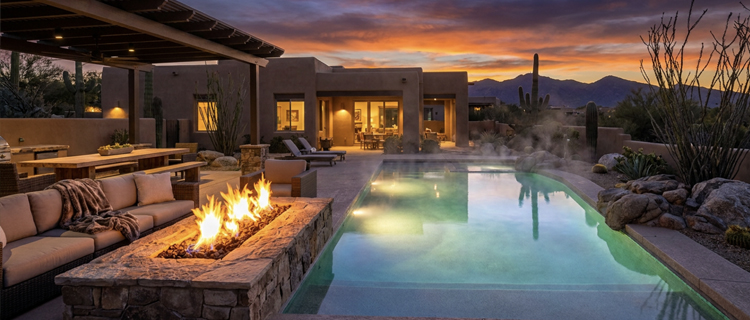
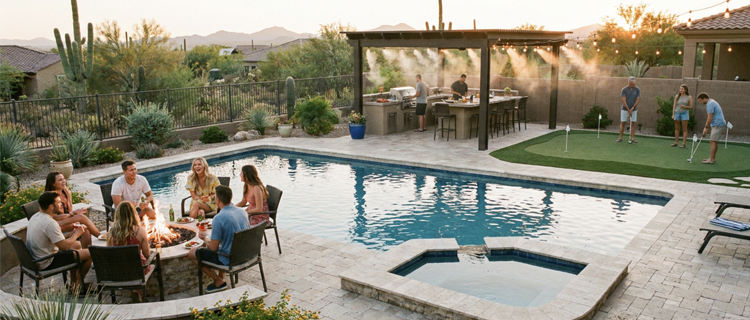
Every market has amenities that matter, but Arizona’s list is delightfully its own. In the desert, the pool is not a nice-to-have; it is the search filter, and a pool that is heated in January is a winter booking machine, because the Valley’s peak season is exactly when an unheated pool goes unused. Outdoor living rooms, misted patios, and fire pits extend the desert’s best asset, its evenings, deep into the year. Casitas unlock the multigenerational bookings that need a second private space, and a putting green in Scottsdale is catnip for the golf groups the city runs on.
Up in the high country, the physics flip. Nobody in Flagstaff is shopping for misters; they want the hot tub under the stars, the wood-burning fireplace staged like a magazine, the game room for snowy evenings, the mudroom that tells ski families this home understands them. Same state, opposite hierarchies, and knowing which list your home lives on is the first step of every smart upgrade conversation.
Great amenities earn twice
Here is the part owners underrate: an amenity earns once in rate and again in photography. A fire pit adds something to the nightly price, but its bigger job is the dusk photo with the chairs waiting, the image that stops the scroll and earns the click. The heated pool books January, and it also gives the listing its glowing hero shot. When you evaluate an upgrade, ask both questions: what does it do to the rate, and what does it do to the photos? The amenities near the top of the ranker below tend to win both.
Effort matters too, and the news is friendly: several of the highest-impact moves are weekend upgrades, not construction. Staging a fireplace properly, adding a fire pit, setting up a real outdoor living space, putting boot trays and hooks in a mudroom: these are decisions, not projects. The genuinely big investments, casitas and sport courts (like Pickleball), belong to owners playing for the group-sized bookings where large homes earn their premium.
Rank your next additions
Pick your region, check what your home already has, and the ranker orders your highest-impact next moves.
Arizona Amenity Impact Ranker
Desert pools or mountain hot tubs: see which amenities move rate and bookings in your region, and your highest-impact next additions.
Both regional amenity hierarchies are below, ranked by illustrative impact. Enable JavaScript to pick your region, check what you already have, and see your highest-impact next additions.
Desert (Valley)High country
Check the amenities you already have0 checked
Your top next additions appear first in the list below. Checked items move to the bottom: they are already working for you.
Impact tiers are illustrative and directional; the right additions depend on your specific home and guests. Porter advises owners on the upgrades worth making and can manage the project through its design and furnishing team.
Deciding what your home actually needs
Top amenities are only as good as they are marketed
Top amenities are only as good as they are marketed.
A ranked list is a starting point; the right call is always home-specific. A Scottsdale home that already books solidly with couples may gain more from a design refresh than a new structure, while a big Flagstaff cabin one bunk room short of sleeping the whole reunion has an obvious next move. The question is never “what is the best amenity,” it is “what does this home need to win the guests it should be winning,”.
This is also exactly the conversation to have with a manager who sees hundreds of homes perform. Porter advises Valley and high-country owners on which upgrades will actually move their number, and its design and furnishing team can run the project end to end. Start with what your home could earn today, and let Porter’s owner team show you which addition changes the answer most.
Frequently asked questions
Which amenities matter most for Arizona vacation rentals?
It depends on the region. In the desert markets, the pool leads (heated for winter), followed by hot tubs, casitas, outdoor living rooms, fire pits, misted patios, and game rooms, with putting greens a Scottsdale favorite. In the high country, the hierarchy flips: a hot tub under the stars, a staged wood-burning fireplace, a game room, view decks, bunk rooms, and a pickleball courts lead the list.
Is heating the pool worth it in winter?
In the Valley, a warm pool in winter is one of the strongest booking levers a home has, because peak season is exactly when an unheated pool goes unused. A heated pool widens winter demand, supports the rate, and gives the listing its glowing hero shot. Many homes pass heating through as a guest option, which keeps the amenity working either way.
What is the cheapest high-impact amenity upgrade?
Several of the strongest moves are weekend upgrades rather than construction: staging a fireplace properly, adding a fire pit with seating, building out a true outdoor living space, adding boot trays and hooks to a mudroom, or setting up a snow-play gear closet in the high country. Each one earns twice, in the stay and in the photos that win the click.
Do amenities really change the nightly rate?
Yes, twice over. Directly, amenities like pools, hot tubs, and casitas support higher rates and widen who can book, especially group-sized guests. Indirectly, they create the photographs that earn the click that everything else depends on. When weighing an upgrade, ask what it does to the rate and what it does to the photos; the best additions answer both.
What about big investments like casitas or sport courts?
They belong to owners playing for the group market, where they genuinely pay: a casita unlocks multigenerational bookings that need a second private space, and reunion-sized homes use courts and game spaces to win trips planned a year ahead. For homes not chasing that tier, a design refresh or a weekend-grade amenity usually moves the number more per dollar.
How do I know which upgrade my home actually needs?
Compare your home to the guests it should be winning: a couples’ hideaway, a family cabin, and a reunion house each have different gaps. This is where a manager who watches hundreds of homes perform earns their advice: Porter tells owners which additions would move their specific number, and its design and furnishing team can run the project. A free estimate is the natural place to start.
Find the upgrade that moves your number
Get a free estimate and ask the team which addition would change your home’s answer most. Porter’s design team can run the project end to end.
Scottsdale’s Marquee Months: When Your Home Becomes the Hottest Ticket in Town
Each winter, Scottsdale compresses enormous demand into marquee windows: Barrett-Jackson in January, the WM Phoenix Open in early February, and Cactus League spring training through March, all on top of winter-long golf-trip season. Group-sized travelers shop these dates months ahead and pay meaningful premiums (illustratively 1.5x to 2.5x+ a typical week) for the right home. Capturing them takes a ready calendar: confident rates, smart minimum stays, and event-aware pricing set well in advance.
Few cities compress this much demand into a winter
Massive revenue opportunities in Scottsdale during marquee weeks
For a few marquee weeks each winter, Scottsdale homes are the hottest tickets in the West.
Scottsdale’s winter is not just a good season; it is a sequence of main events. January brings Barrett-Jackson, the collector-car week that fills the city with enthusiasts and corporate groups. Early February brings the WM Phoenix Open, among the best-attended golf events in the world and famously the sport’s biggest party. Then Cactus League spring training rolls across the Valley for six weeks, as baseball’s fans follow their teams from ballpark to ballpark. Around and between them runs golf-trip season itself, a steady procession of foursomes chasing 75-degree fairways all winter long.
Each of these windows concentrates enormous demand into specific dates, and travelers shopping those dates are group-sized, deadline-driven, and value the right home enormously: the pool, the patio, the parking, the long table, the ten-minute drive. For those weeks, a well-run Scottsdale home is one of the hottest tickets in the West, and it deserves to be treated that way.
The marquee windows, and who books them
Window
When
Who books it
What they want
Barrett-Jackson
January
Collector-car fans, corporate groups, couples making a week of it
Pools, patios, parking, polish
WM Phoenix Open
Early February
Friend groups and corporate crews booking months ahead
Big homes near the action, outdoor living
Cactus League spring training
February to March
Baseball families and fan groups staying for weeks
Longer stays, full kitchens, room for everyone
Golf-trip season
All winter
Foursomes and buddy trips
Proximity to courses, grills, game rooms
Event names and exact dates shift a little each year, and that is fine: the pattern is the constant. The explorer below shows each window with an illustrative premium against a typical winter week, so you can feel the shape of the season.
Scottsdale Event-Season Explorer
Barrett-Jackson, the Open, spring training: see who books each marquee window and what those weeks are worth.
All four marquee windows are below with who books them and an illustrative premium versus a typical winter week. Enable JavaScript for the tap-to-compare view.
Tap a window
WM Phoenix Open week · early February
about 2.6x a typical week
Golf’s biggest party: friend groups and corporate crews who book the best homes months ahead.
Bar shows the illustrative premium relative to the strongest window (the Open, at 2.6x).
Barrett-Jackson weekJanuary
Collector-car fans, corporate groups, and couples making a week of it. Groups want pools, patios, and parking.
Typical winter weekbaseline
This window, illustrativeabout 2.2x the baseline week
WM Phoenix Open weekEarly February
Golf’s biggest party: friend groups and corporate crews who book the best homes months ahead.
Typical winter weekbaseline
This window, illustrativeabout 2.6x the baseline week
Cactus League spring trainingFebruary to March
Baseball families and fan groups following their team across the Valley’s ballparks for weeks at a time.
Typical winter weekbaseline
This window, illustrativeabout 1.8x the baseline week
Golf-trip seasonAll winter
Foursomes and buddy trips chasing 75-degree fairways. Steady premium demand between the marquee spikes.
Typical winter weekbaseline
This window, illustrativeabout 1.45x the baseline week
Premiums are illustrative and vary by home, dates, and year; event names and timing shift annually. Porter prices real event calendars to live demand, with minimum stays that protect the big weeks.
The readiness timeline
Working backward from the season, the calendar has a simple rhythm. By September, the winter should be priced and open, because the earliest event groups are already shopping. Through October, minimum stays go on over the marquee windows and the monthly-stay inquiries start landing for January and February. By Thanksgiving, the best homes have their event weeks spoken for, and December becomes fine-tuning: filling the gaps between bookings, adjusting to how each window is pacing, and letting the late waves of demand meet rates that were set with confidence rather than hope. Owners who join Porter in late summer walk into event season fully armed; owners who wait until January watch the best weeks go to homes that were ready.
Pricing a marquee week is a craft
Revenue management to maximize and drive the most revenue during these times
Professional revenue management allows the marquee weeks reward calendars that were ready for them months in advance.
Marquee weeks punish improvisation and reward preparation. The groups shopping the Open or a Barrett-Jackson week start looking months out, which means the calendar has to be open, priced with confidence, and protected by minimum stays long before the week arrives. Sell those dates too early at ordinary prices and the premium is gone; hold them with no strategy and they can go empty. The craft is in the middle: confident rates, smart minimums so the biggest weekends go to the longest bookings, and the discipline to let real demand meet a ready calendar.
The rest of the winter has its own quiet strength. Between the spikes, golf-trip season and warm-weather travelers keep Scottsdale homes earning steadily, and the season as a whole rewards the blend of premium weeks and settled stays we walk through in the snowbird season. Group-sized homes do especially well in event season, a pattern that echoes across Arizona’s wider seasonal map, and it is why owners considering an upgrade often start with investing in a Scottsdale vacation rental. Porter’s revenue team tracks the real event calendar every year and prices each home’s marquee weeks to live demand; see what your home could earn with its event season handled properly.
Frequently asked questions
What are Scottsdale’s biggest rental demand events?
The winter marquee windows: Barrett-Jackson in January, the WM Phoenix Open in early February, and Cactus League spring training across February and March, all riding on top of golf-trip season, which runs all winter. Each concentrates group-sized demand into specific dates, and exact timing shifts a little each year, so the pattern matters more than any single date.
How much more do homes earn during event weeks?
Illustratively, marquee windows can run from roughly 1.5 to more than 2.5 times a typical winter week for well-run homes, with the Phoenix Open week typically the strongest. Real premiums vary by home, location, and year, which is why the numbers in the explorer are labeled illustrative and why live revenue management beats any fixed calendar.
Who books Scottsdale homes for event weeks?
Groups, overwhelmingly: friend crews and corporate groups for the Open, collector-car enthusiasts and couples for Barrett-Jackson, and baseball families following their teams for weeks of spring training. They shop early, book the best homes months ahead, and value pools, patios, parking, proximity, and room for everyone.
When should my calendar be ready for event season?
Months ahead. Groups shopping the marquee weeks start looking in the fall, so the calendar needs to be open, priced with confidence, and protected by minimum stays well before winter. Selling event dates early at ordinary prices gives the premium away; a ready calendar lets real demand arrive and pay what the week is worth.
What are minimum stays for, during events?
They steer the biggest weekends to the longest, most valuable bookings. A three- or four-night minimum over a marquee window prevents a single peak Saturday from blocking an entire premium week, and event-week guests expect it. Setting minimums well, window by window, is one of the quiet skills that separates managed calendars from improvised ones.
How does Porter handle event pricing?
Porter’s revenue team tracks the real Valley event calendar every year and prices each home’s marquee windows to live demand: confident rates, smart minimum stays, and calendars opened early for the groups that plan furthest ahead. Between the spikes, the same team keeps golf-trip season and winter visitors filling the weeks steadily. A free estimate shows your home’s event-season picture.
Make event season yours
Get a free estimate and see what your Scottsdale home could earn with its marquee weeks priced properly, months before the crowds arrive.
The Science of Revenue Management: How Porter Maximizes Your Arizona Rental Income
Setting the price of a vacation rental looks simple from the outside. Pick a nightly rate, maybe bump it
for holidays, and take the bookings. In reality, the right price for your home changes constantly, by
season, by event, by day of the week, by how fast the calendar is filling, and by which channel a guest is
booking through. Leave money on the table on the busy nights and you never get it back. Overprice the slow
ones and they sit empty.
Revenue management is the discipline of getting that right, deliberately and continuously. At Porter it
is treated as a science: professional revenue managers making the judgment calls, amplified by dynamic
pricing technology and market intelligence that let them act faster and with better information than any
owner could alone. This is how that system works, and why the combination beats either people or software
on their own.
Revenue management is a practice, not a price: a professional amplified by technology and live market data.
Revenue management is not a price. It is a practice
The single most useful reframe for an owner is this: revenue management is not the act of choosing a
number. It is an ongoing practice of adjusting many decisions as conditions change, with the goal of
maximizing total return across the whole year rather than any single night.
The industry has shorthand for the pieces. ADR is your average daily rate.
Occupancy is the share of available nights booked. The art is balancing the two: the highest ADR
in town is worthless if the home sits empty, and full occupancy at a cut rate leaves money behind. Great
revenue management pursues the combination that yields the most revenue per available night over time, and
that target moves every week.
The winning combination: a professional amplified by technology
There is an old debate in this field: should pricing be run by people or by software? Porter’s answer is
that the question is wrong. The winning combination is both, with the technology amplifying the
professional rather than replacing them.
Dynamic pricing tools are extraordinary at scale and speed. They can reprice thousands of date-and-home
combinations every day against live supply and demand signals, something no human could do by hand. What
they lack is judgment. They do not know that a specific event is bigger this year, that a comparable listing
just went offline, or that a booking pace looks soft for a reason that will correct. A professional revenue
manager supplies that judgment: setting the strategy, checking the machine, overriding it when reality and
the model disagree, and catching the opportunities and risks software misses. Data makes the person sharper.
The person makes the data wise.
The revenue engine, from inputs to owner return
The diagram below shows how the pieces fit together. Two engines (dynamic pricing technology and market
data intelligence) feed a professional revenue manager, who pulls a set of levers on your calendar and
coordinates with marketing. Open each lever to see how Porter uses it.
The science of revenue management
How Porter Amplifies a Revenue Manager
A person sets the strategy. Technology and market data make that person faster and sharper.
Here is how the pieces fit, and the levers they pull on your calendar.
Dynamic pricing technology
Automated tools reprice thousands of date-and-home combinations against live supply and demand.
Market data intelligence
Comp sets, pacing, and event calendars show what the market will actually pay, by date and area.
↓
Amplify a professional revenue manager whose judgment sets strategy, checks the
machine, and makes the calls software cannot.
↓
The levers they pull
Seasonality+
Rates rise and fall with Arizona’s two-clock calendar: cool-season Valley peaks and warm-season high-country demand.
What it means for owners: Prices track the calendar so you capture peak willingness-to-pay and stay competitive in the shoulders.
Events+
Barrett-Jackson, the WM Phoenix Open, Cactus League, festivals and conferences get priced as the demand spikes they are.
What it means for owners: Marquee weekends are priced up deliberately instead of being sold at an ordinary nightly rate.
Weekly demand+
Pacing is reviewed continuously. Soft mid-week windows and slow pickup get different treatment than a selling-out weekend.
What it means for owners: Gaps are filled and strong dates are protected, smoothing occupancy across the whole month.
Nightly minimums+
Minimum-stay and length-of-stay rules flex by date to protect high-value windows and avoid orphan gap nights.
What it means for owners: You avoid stranded one-night holes and keep the calendar efficient without leaving money on the table.
OTA vs direct+
Rates and availability are managed by channel, balancing marketplace reach against lower-cost direct and repeat bookings.
What it means for owners: Demand is steered toward the healthiest mix instead of paying full marketplace cost for every night.
Strategic discounting+
When it helps, targeted, time-boxed offers capture the froth on top of demand without eroding your base rate.
What it means for owners: Discounts are a scalpel, used to win specific nights, not a blunt across-the-board price cut.
↻ The marketing loop
Revenue management is not a silo. When pricing alone cannot fill demand, the team taps
marketing and Porter’s tens of thousands of past guests, so pricing and marketing push toward one goal:
revenue for owners.
One aligned system, one outcome: maximum revenue for your home.
Illustrative overview of Porter’s revenue-management approach. Named events and seasonal
patterns are Arizona-specific and change year to year. Actual results depend on the home, market, and conditions.
Notice that the human sits in the middle on purpose. Everything flows through a person accountable for
the outcome, which is what keeps the system pointed at your revenue rather than at a model’s idea of it.
Dynamic pricing: seasonality, events, and market shifts
The foundation of the system is dynamic pricing: rates that move with demand instead of sitting at a
fixed number. Three forces drive most of that movement.
Seasonality
Arizona runs on two clocks. The Valley (Scottsdale, Phoenix, Paradise Valley) fills in the cool months
when snowbirds and sun-seekers arrive, while the high country around Flagstaff fills in summer, and Sedona
peaks in spring and fall. Good pricing tracks that calendar closely, climbing into each market’s peak and
staying competitive through the shoulders. Our guide to
the two Arizona rental
seasons maps the pattern in detail.
Events
Marquee events are demand spikes, and they should be priced as such. Barrett-Jackson in January, the WM
Phoenix Open in February, and Cactus League spring training draw crowds willing to pay a premium, and a home
priced at its ordinary rate during those weekends is a missed opportunity. Porter prices marquee dates
deliberately, as covered in our piece on Scottsdale’s marquee months.
Market shifts
Beyond the calendar, live market data matters. Revenue managers watch comp sets (the truly comparable
listings nearby), booking pace, and how supply and demand are moving right now. If competitors go dark, if a
new wave of listings appears, or if pace suddenly slows, the strategy adjusts. Pricing against yesterday’s
market is how money gets left on the table.
The tactical layer: demand, minimum stays, channels, and discounts
Strategic pricing management with a professional revenue manager amplified by dynamic pricing tools.
Seasonality and events set the broad strokes. The gains that separate a good year from a great one come
from the tactical layer, worked continuously.
Weekly demand management
Pacing is reviewed constantly. A weekend that is selling out gets treated very differently from a soft
mid-week window with slow pickup. The goal is to fill the gaps without discounting the nights that would
have sold anyway, smoothing occupancy across the whole month.
Strategic minimum-stay rules
Minimum-stay and length-of-stay settings are a quiet source of revenue. Flexed by date, they protect
high-value windows (a three-night minimum over a big event) and prevent orphan gap nights, the stranded
single nights between bookings that are hard to sell. Managed well, minimum stays keep the calendar
efficient without turning away good demand.
OTA versus direct channel strategy
The same home can be priced and positioned differently by channel. Balancing marketplace reach against
lower-cost direct and repeat bookings steers demand toward the healthiest mix rather than paying full
marketplace cost for every night. Our look at
the channels guests come
through explains how that network is built.
Strategic discounting
Finally, when it helps, targeted and time-boxed discounts capture the froth on top of demand: winning a
specific soft night without eroding your base rate. Used as a scalpel rather than a blunt instrument,
discounting fills the calendar without training the market to expect a lower price.
Revenue management is not a silo
Here is the part many managers miss. Pricing has limits. There are windows where no rate, however sharp,
will conjure demand that is not in the market that week. When that happens, price alone cannot fill the
calendar, and a pricing-only team is stuck.
Porter treats revenue management as a team sport instead of a silo. When pricing cannot create demand,
the revenue team taps marketing, and marketing reaches into Porter’s base of tens of thousands of past
guests to generate it. Pricing and marketing push toward a single shared goal: revenue for owners. That
coordination, explored further in our piece on the
recurring-guest
strategy, is what lets the system keep working when the pricing lever alone runs out of room.
What owners should expect from a revenue team
If you are evaluating how a manager handles pricing, a few things separate a real revenue operation from
a set-and-forget listing. There should be a person accountable for your revenue, not just an algorithm.
There should be evidence the calendar is actively managed: rates that move with season, event, and pace, not
a flat number. And there should be a link between pricing and marketing, so soft demand has more than one
answer.
Curious what the upside looks like for your specific home? Our
Arizona income estimator
gives an illustrative starting range, and a conversation with Porter turns that into a strategy built around
your property, your market, and the way demand actually moves through the Arizona year.
Frequently asked questions
What is revenue management for a vacation rental?
Revenue management is the ongoing practice of pricing and positioning a home to earn the most across a full year, not just to fill nights. It balances average daily rate against occupancy and adjusts continuously for season, events, booking pace, minimum-stay rules, and channel mix. The goal is the highest sustainable return on your calendar, not the highest rate or the highest occupancy alone.
Is dynamic pricing software enough on its own?
No. Dynamic pricing tools are excellent at scale and speed, repricing thousands of dates against live demand, but they lack judgment. They miss when an event is bigger this year, when a competitor goes offline, or when soft pace will correct. Porter pairs the software with professional revenue managers who set strategy and override the model when reality and the numbers disagree.
How does Porter price for Arizona’s seasons and events?
Porter prices to Arizona’s two-clock calendar, climbing into the Valley’s cool-season peak and the high country’s summer, and it treats marquee events like Barrett-Jackson, the WM Phoenix Open, and Cactus League as the demand spikes they are. Named events and their timing shift year to year, so the strategy is reviewed against current market data rather than set once.
What are minimum-stay rules and why do they matter?
Minimum-stay, or length-of-stay, rules set how many nights a guest must book on given dates. Flexed by date, they protect high-value windows such as big event weekends and prevent orphan gap nights, the stranded single nights between bookings that are hard to sell. Managed well, they keep the calendar efficient without turning away good demand.
Why does Porter price differently across OTAs and direct channels?
Because the cost and value of a booking differ by channel. Marketplaces like Airbnb and Vrbo deliver broad reach but charge for it, while direct and repeat bookings cost less to win. Managing rates and availability by channel steers demand toward the healthiest mix instead of paying full marketplace cost for every night.
What happens when pricing alone cannot fill the calendar?
There are weeks when no rate will create demand that is not in the market. Porter treats this as a team problem rather than a pricing dead end: the revenue team coordinates with marketing, which re-engages Porter’s base of past guests to generate demand. Pricing and marketing work toward the same goal, so a soft window has more than one lever.
Will lots of discounting hurt my home’s value?
It can, if discounting is used bluntly and constantly, because it trains the market to wait for a lower price. Porter uses discounting strategically: targeted, time-boxed offers to win specific soft nights without eroding the base rate. Used as a scalpel rather than a default, it fills gaps while protecting your pricing power.
See what disciplined revenue management could do for your home
Porter pairs professional revenue managers with dynamic pricing technology and live market data to pursue the maximum return on your calendar. Let’s talk about your home’s revenue potential.
Phoenix and Scottsdale with Kids: Family Attractions, Splash Pads, and Rainy-Day Backups
Phoenix and Scottsdale reward families who plan around one thing: the heat. Get the timing right and the Valley of the Sun turns into an easy kid trip, with a world-class aquarium, a walk-through butterfly pavilion, a real steam-era railroad park, splash pads on nearly every block, and short desert hikes a four-year-old can finish. Get it wrong and you spend the afternoon melting in a parking lot. The rhythm is simple once you know it: outdoors early, water or air conditioning at midday, back outside at sunset.
This is a specific, age-aware guide to a Valley family trip. It names the marquee attractions worth your time and which ages each one suits, points you to water play, covers the easiest kid hikes, lists the indoor backups that rescue a hot afternoon, and shows how to time the whole trip by month. Most “things to do with kids” lists skip the part that actually matters here, which is how to keep a toddler and a ten-year-old both happy when it is 105 degrees outside.
The Short Answer The best Phoenix and Scottsdale family trip pairs one or two marquee attractions with pool time and an indoor backup, all planned around the heat. Toddlers love Butterfly Wonderland, McCormick-Stillman Railroad Park, and the Children’s Museum of Phoenix. Older kids do well at OdySea Aquarium, the Phoenix Zoo, and the Musical Instrument Museum. Add the short Hole-in-the-Rock trail at Papago Park, cool off at a splash pad, and save outdoor spots for early morning. November through April is the easy season. In summer, go out at dawn and swim by midday.
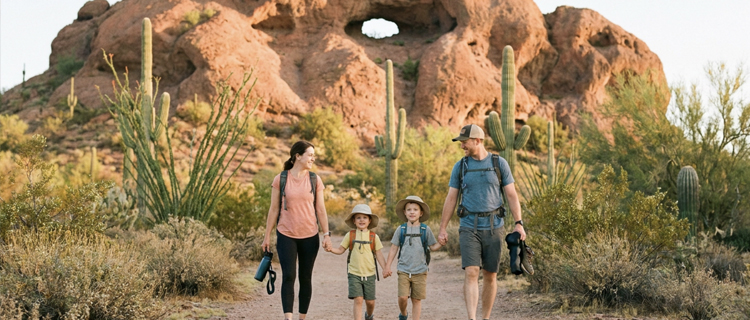
Family vacation starting with a hike in Phoenix.
The marquee family attractions
Pick one or two marquee attractions a day, not all seven. Each of these is a half-day on its own, and stacking them turns a fun trip into a forced march with a cranky toddler. The table below sorts them by the ages they suit best and whether they are indoor (air-conditioned) or outdoor, so you can match the plan to your kids and the forecast. Prices and hours below were current at the time of writing; always confirm on the official site before you go, since several use seasonal hours or date-based pricing.
Attraction
Where
Best for ages
Indoor / Outdoor
Good to know
OdySea Aquarium
Salt River / Scottsdale
3 to 12, works for all
Indoor (AC)
Adults about $49.95, kids 2 to 12 about $39.95; discounted twilight tickets after 4:30 p.m.
Butterfly Wonderland
Scottsdale (Arizona Boardwalk)
Toddlers to early elementary
Indoor (AC)
Calm, stroller-friendly; sits right next to OdySea, so families often pair them
Phoenix Zoo
Papago Park, Phoenix
All ages, toddlers to 10
Outdoor
Adults about $39.95, kids 3 to 13 about $29.95, under 3 free; summer hours end at 1 p.m., so go early
Musical Instrument Museum
North Phoenix
6 and up, plus a hands-on gallery
Indoor (AC)
Adults $20, teens 13 to 19 $15, kids 4 to 12 $10, under 4 free; open daily 9 a.m. to 5 p.m.
Children’s Museum of Phoenix
Downtown Phoenix
Birth to 10, toddlers shine
Indoor (AC)
Admission about $19, under 1 free; three floors of climb-and-play exhibits
McCormick-Stillman Railroad Park
Scottsdale
Toddlers to 8
Outdoor
Free to enter and park; rides $3 each, 8-pack $20, all-day wristband $12; under 2 ride free
Desert Botanical Garden
Papago Park, Phoenix
All ages, best with a stroller
Outdoor
Timed-entry tickets around $30 or more for adults, less for kids; go early or for evening events
Aquarium and butterflies (the reliable heat-beaters)
OdySea Aquarium and Butterfly Wonderland sit side by side at the Arizona Boardwalk on the Salt River Pima-Maricopa land, just off the Loop 101 in the Scottsdale area, and together they make the strongest hot-day plan in the Valley. OdySea is the largest aquarium in the Southwest, with a rotating tunnel of tanks and a sea-lion show that holds a five-year-old’s attention. General admission runs about $49.95 for adults and $39.95 for kids ages 2 to 12, and the discounted twilight tickets after 4:30 p.m. are a smart move if you would rather cap a pool afternoon than start the day here. Next door, Butterfly Wonderland is a warm, humid walk-through pavilion where hundreds of butterflies land on strollers and shoulders; it is calm, short, and about as toddler-proof as an attraction gets.
The zoo and the botanical garden (early birds only in summer)
The Phoenix Zoo and the Desert Botanical Garden share Papago Park and both reward an early start. The zoo is large and mostly outdoors, with a stingray touch tank, a splash playground, and a petting-zoo barn that younger kids gravitate to. Adult admission runs about $39.95 and kids 3 to 13 about $29.95, with under-3s free, and in the deep summer the zoo opens at dawn and closes by early afternoon precisely because of the heat, so treat it as a morning-only outing from June through August. A short walk away, the Desert Botanical Garden spreads 50 acres of cactus and desert trails; it is stroller-friendly and genuinely pretty at golden hour, and its butterfly exhibit and seasonal family events are a hit with school-age kids. Tickets are timed and priced by date, so book online ahead.
Museums and the railroad park
For indoor days, the two museums split neatly by age. The Musical Instrument Museum in north Phoenix suits kids around six and up, with headphones that play each gallery’s instruments as you approach and a hands-on Experience Gallery where kids bang gongs and strum harps; admission is $20 for adults, $15 for teens, and $10 for kids 4 to 12, and it is open daily from 9 a.m. to 5 p.m. Downtown, the Children’s Museum of Phoenix is built for the youngest crowd, birth through about age ten, with three floors of tactile, climb-through exhibits and admission around $19. Out in Scottsdale, McCormick-Stillman Railroad Park is the sleeper hit for train-obsessed toddlers: entry and parking are free, and the scaled-down railroad, the 1950 carousel, and the playgrounds run on cheap ride tickets ($3 each, or an all-day wristband for $12). Kids under two ride free.
Water play: splash pads and pools
Water is the Valley’s default kid activity, and most of it is free. Cities across the metro run public splash pads, also called spray pads, that turn on for the warm months and cost nothing to use; the City of Scottsdale’s park finder and Phoenix’s parks pages list current locations and seasonal schedules, which typically run spring through fall. Eldorado Park in Scottsdale and Steele Indian School Park in central Phoenix are two well-known spots, and many neighborhood parks have a smaller pad tucked in beside the playground.
Splash pads are perfect for toddlers because there is no standing water to worry about, but the single biggest water amenity for a family trip is a private pool at your rental. In a climate where midday belongs indoors or in the water from late spring through early fall, a home pool is what lets you build the whole day around a swim rather than driving to a crowded public pool. Municipal pools and resort water features are the backup plan; a pool in the backyard is the plan. Check that any pool you are counting on is heated if you are visiting between November and March, when desert nights turn cool and unheated water stays too cold for kids.
A family trip to Phoenix in a Stay Porter vacation rental.
Easy kid hikes: Hole-in-the-Rock
For families with young kids, the easiest real hike in the Valley is Hole-in-the-Rock at Papago Park, a short, mostly flat walk to a natural sandstone opening you can climb into for a view over Phoenix. It is under a half mile round trip with a little gentle scrambling at the end, it is free, and it sits right between the Phoenix Zoo and the Desert Botanical Garden, so it folds neatly into a Papago Park morning. The City of Phoenix describes Papago’s trails as generally easy with smooth footing and low elevation gain, which is exactly what you want with short legs along.
Skip Camelback Mountain with young kids. It is the Valley’s most famous hike for a reason, but both routes up Camelback Mountain are steep, exposed, hand-over-hand climbs that regularly send unprepared adults to the emergency room, not a toddler outing. For older, sure-footed kids who want more than Hole-in-the-Rock, the paved and packed-dirt loops at Papago and the gentler stretches of the Valley’s preserves are better bets; StayPorter’s guide to Scottsdale and Phoenix hiking trails lays out the options by difficulty. Whatever you pick, hike it early: start at sunrise, carry far more water than you think you need, and be off the trail before mid-morning from spring through fall.
Indoor and beat-the-heat backups
In Phoenix, the backup you actually need is for heat, not rain. The metro sees only a handful of rainy days a year, so “rainy-day plan” here really means “it is too hot to be outside this afternoon.” The good news is that the Valley is full of air-conditioned options built for exactly that window between late morning and evening.
Keep a short list of indoor resets ready: OdySea Aquarium, Butterfly Wonderland, the Musical Instrument Museum, and the Children’s Museum of Phoenix are all fully indoors and each buys you two or three cool hours. Beyond those, the Valley has the usual family standbys, indoor trampoline parks, children’s play cafes, movie theaters, the OdySea complex’s aquarium-adjacent attractions, and shopping centers with kid zones, most of which sit within a short drive of Phoenix and Scottsdale rentals. The one genuine rainy stretch to plan for is monsoon season, roughly mid-June through September, when hot afternoons can end in a sudden thunderstorm or dust storm. Those storms pass quickly, but they are a good reason to keep the afternoon flexible and indoors during those months.
Heat rule of thumb From June through September, Phoenix afternoons average 100 to 107 degrees. Treat 10 a.m. to 5 p.m. as pool-or-indoor time in those months, and save the zoo, the botanical garden, and any hiking for the cooler hours right after sunrise.
When to visit with kids
The easy season for a Valley family trip is November through April, when highs sit in the comfortable 60s to mid-80s and every attraction, trail, and splash of shade is genuinely pleasant all day. That window covers the winter holidays, spring break, and the wildflower-and-baseball weeks of March, which is also the busiest and priciest stretch, so book early if you are traveling then.
Summer is the honest tradeoff. From June through September, average highs run 100 to 107 degrees, per National Weather Service climate normals, and June through August routinely top that. Summer is not off-limits with kids, it is just a different playbook: you go out at dawn for the zoo or a splash pad, spend the blazing midday in the pool or an air-conditioned museum, and come back out after sunset. Summer is also the Valley’s low season, which means the best rates of the year on family homes with pools. Two timing notes worth planning around: the Phoenix Zoo shifts to early-morning-only summer hours, and monsoon storms can roll in on July and August afternoons, so keep those hours loose.
Season
Typical highs
What it means for a family trip
Winter (Dec to Feb)
Mid-60s to low 70s
Easiest weather, all-day outdoor time; cool nights, so heat the pool
Spring (Mar to Apr)
Upper 70s to upper 80s
Peak season and spring break; ideal weather, highest prices, biggest crowds
Summer (Jun to Sep)
100 to 107
Dawn-and-dusk plan, midday in the pool; lowest prices; watch for monsoon
Fall (Oct to Nov)
80s cooling into 70s
Heat breaks, crowds thin, outdoor days return; strong value
Where to stay with a family
The lodging choice that keeps every age happy is a family home with a private pool and a game room. In a destination where the pool is the plan for half the year, having your own in the backyard means naptime, midday swims, and after-dinner splashing without loading everyone back into a hot car. Add a game room with a pool table, arcade cabinet, or bunk room and the older kids have somewhere to land on a triple-digit afternoon while the toddlers nap. A house also gives you a full kitchen for early breakfasts before a sunrise zoo run and a laundry room for the inevitable splash-pad soakings, which a hotel room simply cannot.
For location, families usually do well basing in the Scottsdale corridor or the greater Phoenix area near Papago Park, both within a short drive of the aquarium, the zoo, the museums, and the railroad park. Browse Scottsdale vacation rentals for pool homes near OdySea, Butterfly Wonderland, and McCormick-Stillman Railroad Park, or Phoenix vacation rentals to sit closer to the Papago Park cluster and downtown’s Children’s Museum. Filter for a private pool and the bedroom count your group needs, and confirm the pool is heated if you are visiting in the cooler months.
Frequently asked questions
What are the best things to do in Phoenix with toddlers?
For toddlers, the standouts are Butterfly Wonderland, McCormick-Stillman Railroad Park, and the Children’s Museum of Phoenix. All three are calm, short, and built for little kids: the butterfly pavilion is a gentle stroller walk, the railroad park runs cheap train and carousel rides with free entry, and the museum’s ground floors are pure hands-on play. Add a free splash pad and pool time, and skip the long, outdoor-heavy attractions until they are older.
Where can I find splash pads in Phoenix and Scottsdale?
Cities across the metro run free public splash pads, also called spray pads, that operate through the warm months. Scottsdale’s Eldorado Park and central Phoenix’s Steele Indian School Park are two well-known spots, and many neighborhood parks have a smaller pad beside the playground. Check the City of Scottsdale and City of Phoenix parks pages for current locations and seasonal on-off dates. A private pool at your rental is the most reliable water option of all.
What is there to do indoors on a hot Phoenix day?
The best air-conditioned family attractions are OdySea Aquarium, Butterfly Wonderland, the Musical Instrument Museum, and the Children’s Museum of Phoenix, each good for two or three cool hours. Beyond those, indoor trampoline parks, play cafes, movie theaters, and mall kid zones fill an afternoon. Plan on the window from late morning to early evening being indoor or pool time from roughly June through September, when highs sit around 100 to 107 degrees.
What is the best time of year to visit Phoenix with kids?
November through April is the easiest window, with highs in the 60s to mid-80s and comfortable all-day outdoor time. March and spring break are the peak for weather, crowds, and price. Summer, June through September, averages 100 to 107 degrees, so it works only with a dawn-and-dusk plan and a pool, but it brings the lowest rates of the year. Fall shoulder weeks offer a strong mix of cooling weather and value.
Which easy hike is best for young kids near Phoenix?
Hole-in-the-Rock at Papago Park is the best easy hike for young kids. It is under a half mile round trip, mostly flat with a little gentle scrambling to a natural sandstone opening, and it is free. It sits between the Phoenix Zoo and the Desert Botanical Garden, so it slots into a Papago Park morning. Skip Camelback Mountain with young children; both routes are steep, exposed climbs that are not suitable for little kids.
Is OdySea Aquarium or the Phoenix Zoo better for young kids?
Both work, and the deciding factor is the weather. OdySea Aquarium is fully indoors and air-conditioned, which makes it the better pick for a hot midday or a summer trip. The Phoenix Zoo is mostly outdoors and more physical, so it shines in the cooler months and in the early morning; in deep summer it opens at dawn and closes by early afternoon. Toddlers do a little better at the aquarium; active school-age kids often prefer the zoo.
Do we need a private pool for a family trip to the Valley?
Not strictly, but from late spring through early fall a private pool changes the trip. When midday belongs indoors or in the water, a pool in the backyard lets you build the day around a swim instead of driving to a crowded public pool. It also gives you naptime and after-dinner water play without leaving the house. If you visit between November and March, make sure the pool is heated, since desert nights turn cool and unheated water stays too cold to swim.
Planning a Valley family trip? A home with a private pool and a game room keeps toddlers and big kids happy through the hottest part of the day, with room to spread out and a kitchen for early starts. Browse StayPorter’s Phoenix and Scottsdale family rentals, filter for a heated pool and the bedrooms you need, and base yourself a short drive from the aquarium, the zoo, and the railroad park.
A Girls’ Weekend in Scottsdale: Where to Stay, Eat, and Play
Scottsdale has quietly become one of the country’s favorite bachelorette and girls’-trip towns, and it earns the title. In one compact desert city you get boozy brunches, day clubs and resort pools, spa afternoons, Arizona wine tasting, boutique shopping, and a walkable nightlife district where nobody has to drive. Fly in Friday, base everyone in one house, and the whole weekend runs on rideshare and good timing.
The trick is sequencing it so the plan feels effortless instead of scattered. This is a paced, bachelorette-ready weekend built around real, currently operating venues: where to base the group, where to eat, how to fill the pool-to-patio-to-nightlife arc of each day, the one signature group activity worth setting an alarm for, and when to come so the heat works for you rather than against you.
You could base your Scottsdale girls’ weekend in Old Town, book one large home with a private pool instead of splitting resort rooms, and travel in spring (roughly March and April) or a shoulder month for the best mix of weather and value. Fill days with brunch, a day club or resort pool, a spa afternoon, and Arizona wine tasting, then walk to nightlife in the Entertainment District. Make a sunrise hot-air balloon ride the signature group outing, and get everywhere by rideshare so no one drives.
A private pool home in Old Town Scottsdale keeps a girls’ weekend together, from morning coffee to golden-hour cocktails.
Why Scottsdale, and why Old Town
Scottsdale works for a girls’ weekend because everything a group wants sits close together and stays open year-round. Old Town Scottsdale is the walkable core, and it should be your base. Within a few blocks you have brunch patios, wine tasting rooms, boutiques, day spas, and the bars and clubs of the Entertainment District, so evenings become a stroll rather than a logistics problem. It is also the shortest hop from Phoenix Sky Harbor, roughly 15 to 20 minutes in normal traffic, which matters when half the group lands on different flights.
The rest of the metro area is easy to reach from here by rideshare when you want a day club up the road or a sunrise balloon launch out in the desert. For a fuller rundown of the district itself, StayPorter’s guide to fun things to do in Old Town Scottsdale covers the art walk, the historic core, and more.
Where to stay: one pool home, not five rooms
For a group, a large private home with a pool beats splitting resort rooms almost every time. You get one place to gather, a full kitchen for coffee and champagne, a private pool for the down hours, and a per-person cost that usually lands well under separate hotel rooms once you divide it. Just as important, you get somewhere to host: pregame, get ready together, order in on a low-key night, and keep the celebration under one roof.
Book a home in or near Old Town so the group can walk or take a two-minute ride to dinner and drinks. Look for the features a girls’ trip actually uses: enough bedrooms and bathrooms that mornings do not back up, a private heated pool and hot tub, good outdoor seating, and parking if anyone drives in. Walkable Old Town Scottsdale rentals put the district at your doorstep, while the broader range of large Scottsdale homes with private pools gives you more space and bedrooms a short ride from the action.
Consideration
Private pool home
Separate resort rooms
Togetherness
Everyone under one roof, one pool, one kitchen
Group split across floors or buildings
Cost per person
Usually lower once divided
Higher, especially in peak season
Hosting and getting ready
Full kitchen and shared space to gather
Cramped in a standard room
Privacy
Private pool and yard
Shared, busy resort pool
Best for
Bachelorette and birthday groups of 6 to 12
Very small groups wanting resort service
Where to eat: brunch and coffee
Brunch is the anchor meal of a Scottsdale girls’ weekend, so build each morning around it. Old Town and the surrounding Scottsdale Road corridor are thick with reservation-worthy spots. Hash Kitchen leans into the boozy-brunch theme with a build-your-own bloody mary bar and a party atmosphere, which suits a celebration. For something lighter and health-forward, Farm & Craft does bright, veggie-heavy plates and wellness cocktails, and Morning Squeeze is a reliable, high-energy breakfast standby. Reserve ahead for any weekend brunch, because the good tables go fast.
Slower mornings call for good coffee first. The area has a strong independent scene, and StayPorter rounds up a handful in its guide to the top coffee shops in Scottsdale. Grab cold brew for the house, then let the day unfold from the pool.
Pools, day clubs, and spa days
Midday belongs to the water and the spa, which is exactly how you pace a hot-weather trip. You have three lanes here, and most groups mix them across a weekend.
Day clubs and pool parties
For a high-energy scene with DJs, cabanas, and bottle service, Scottsdale’s day club is Maya Day + Night Club in the heart of Old Town, a staple of bachelorette weekends. Resort pool parties, including the scene at Talking Stick Resort, add more options in the warm months. Day clubs and pool parties are seasonal and busiest from spring into early fall, so check the current event calendar and reserve a table or cabana in advance, especially for a big group on a Saturday.
Resort pools without booking a room
You do not have to be a hotel guest to lounge at a resort pool. Day-pass services such as ResortPass sell access to pools and cabanas at properties around Scottsdale, from The Phoenician to Hotel Valley Ho, so you can trade your home pool for a resort scene for an afternoon. Availability and pricing change by date, so book the day pass ahead.
Spa and med-spa afternoons
A spa block is the calm counterweight to the late nights. Scottsdale is a spa town, with hotel spas like the one at Hotel Valley Ho and The Phoenician alongside a dense field of day spas and med-spas offering facials, massages, and quick aesthetic treatments. If anyone wants a med-spa treatment, book it early in the trip and with a licensed provider, and skip anything invasive right before pool days or flights.
Enjoy your girls’ weekend in a vacation rental to regroup and have fun relaxing.
Wine tasting and boutique shopping
Late afternoon is made for a wine crawl and a little shopping, both walkable from an Old Town base. The Old Town Scottsdale Wine Trail links several Arizona tasting rooms within a few blocks, including LDV Winery, Salvatore Vineyards, Carlson Creek Vineyards, Los Milics Vineyards, Aridus Wine Company, and The Wine Collective of Scottsdale. Rock musician Maynard James Keenan’s Merkin Vineyards also runs an Old Town tasting room and osteria. You can taste your way through several without moving the car, which is the whole point.
Between pours, the boutiques along Fifth Avenue, Main Street, and Marshall Way are built for browsing, with local clothing shops, jewelry, art galleries, and Southwestern finds. It is easy to fold shopping into the same stretch of afternoon as a tasting, then head back to the house to change for dinner.
Nightlife in the Entertainment District
Old Town’s Entertainment District is the reason a car is optional: bars and clubs cluster within a few walkable blocks, so the night moves on foot. The lineup runs from country dance halls like Dierks Bentley’s Whiskey Row to high-energy spots such as Casa Amigos and Bottled Blonde, plus Maya after dark. For a current, curated list, Experience Scottsdale keeps a running guide to Old Town nightlife hot spots.
A few practical notes for a group: many clubs enforce dress codes and take table reservations, which are worth it for a large party that wants guaranteed space and a place to sit. Weekend lines build late, so start earlier, and because everything is walkable or a short rideshare away, plan on nobody driving.
The signature group activity
If you do one organized outing together, make it a sunrise hot-air balloon ride over the Sonoran Desert. It photographs beautifully, it suits every fitness level, and doing it at dawn means you are back with the day still ahead of you. Established operators such as Rainbow Ryders fly the Phoenix and Scottsdale area, with roughly 45 minutes to an hour of flight time and about three and a half to four hours from pickup to return, often finished with a champagne toast.
Timing matters. Sunrise flights run year-round, while sunset flights are typically offered only in the cooler months from about November through March, since summer heat pushes flights to the early morning. Balloon rides depend on weather and can be rescheduled for wind, so book it for early in the weekend to leave a backup window, and reserve well ahead for a larger group.
When to go: spring vs. summer heat
Spring is the sweet spot, and summer is the value play. According to Experience Scottsdale’s climate data, average highs climb from about 78 degrees in March to 86 in April and 95 in May, then spike into triple digits: roughly 103 in June, 105 in July, and 103 in August. Spring, especially March and April, gives you warm pool weather without the punishing afternoon heat, which is why it is peak season and books up early.
Summer is genuinely hot, but it is also low season, and resort and rental rates drop steeply, in some cases up to 60 percent off peak pricing. A summer girls’ weekend can absolutely work if you plan around the heat: pool and spa by day, everything else after sunset. StayPorter’s Scottsdale summer and fall guide lays out the warm-weather playbook and the indoor options for the hottest hours.
Season
Typical daytime highs
What it means for the trip
Spring (Mar to May)
About 78 to 95°F
Best all-around weather; peak prices; book early
Summer (Jun to Aug)
About 103 to 105°F
Lowest rates; plan pool by day, go out at night
Fall and winter
Mild to warm
Comfortable, but cooler for pool time
Getting around without a car
You do not need to rent a car if you base in Old Town. Rideshare through Uber and Lyft is plentiful across Scottsdale and covers the short hops to day clubs, brunch, and the airport, so the group can enjoy the wine and nightlife without a designated driver. Within Old Town itself, most of the dining, tasting rooms, boutiques, and bars are close enough to walk, and the city’s free Scottsdale Trolley loops through the district and nearby areas.
Keep a couple of things in mind for a group. Rideshare surge pricing kicks in late on weekend nights when everyone leaves the clubs at once, so budget for it or leave a few minutes early. A car only earns its keep if you plan a lot of far-flung outings, and even then, a single rental or a driver for the day usually beats making everyone drive.
A sample three-day itinerary
Here is a paced weekend that hits every category without overpacking the days. Shift the balloon ride to Sunday if the forecast looks better, and swap the day club for a resort pool if your group prefers a calmer scene.
Day
Daytime
Evening
Friday
Arrive, settle into the house, grocery and champagne run, afternoon by the private pool
Group dinner in Old Town, then a walkable bar crawl through the Entertainment District
Saturday
Boozy brunch, then a day club or resort pool with a reserved cabana
Spa or med-spa reset, dinner, then Old Town nightlife
Sunday
Sunrise hot-air balloon ride, slow coffee, and the Old Town wine trail with boutique shopping
Relaxed dinner or a night in at the house before departures
Frequently Asked Questions
What is the best area for a bachelorette in Scottsdale?
Old Town Scottsdale is the best base for a bachelorette or girls’ trip. It is the walkable core, with brunch spots, wine tasting rooms, boutiques, spas, and the Entertainment District’s bars and clubs all within a few blocks, plus a day club right in the district. It is also closest to Phoenix Sky Harbor, about 15 to 20 minutes, and rideshare covers any longer hops, so the group can skip renting a car.
What is the best time of year to avoid the heat?
Spring, roughly March and April, is the sweet spot, with average highs around 78 to 86 degrees, warm enough for the pool but not punishing. That is peak season, so book early. Summer highs run about 103 to 105 degrees, which is low season with rates dropping steeply, up to 60 percent off. Summer works if you plan pool time by day and go out after sunset.
Do you need a car for a Scottsdale girls’ weekend?
No, not if you base in Old Town. Most brunch, tasting rooms, shopping, and nightlife are within walking distance, and rideshare through Uber and Lyft handles the airport run and trips to day clubs or a balloon launch. Skipping the rental means no designated driver, which fits a weekend built around wine and nightlife. A car only pays off if you plan many outings far from Old Town.
Is it better to book a house with a pool or a resort?
For a group, a large home with a private pool usually beats splitting resort rooms. You get one place to gather, a full kitchen, a private pool and hot tub, and a lower cost per person once you divide it. It also gives you room to host and get ready together. Separate resort rooms make more sense only for very small groups who specifically want full resort service.
What is the signature group activity in Scottsdale?
A sunrise hot-air balloon ride over the Sonoran Desert is the standout group outing. It suits every fitness level, photographs well, and finishes early enough to leave the day open. Established operators like Rainbow Ryders fly the Phoenix and Scottsdale area, with about 45 minutes to an hour aloft and roughly three and a half to four hours door to door. Flights depend on weather, so book early in the trip with a backup window.
Where should the group go for brunch?
For a celebration, Hash Kitchen leans into the boozy-brunch theme with a build-your-own bloody mary bar and a party atmosphere. Farm & Craft is the health-forward pick, with bright, veggie-heavy plates and wellness cocktails, and Morning Squeeze is a dependable, high-energy breakfast. Weekend brunch fills up fast in and around Old Town, so make a reservation for the group ahead of time.
When do Scottsdale day clubs and pool parties happen?
Day clubs and resort pool parties are seasonal, busiest from spring into early fall when the weather is warm. Maya Day + Night Club in Old Town anchors the scene, and resorts add pool parties in the warm months. Events, hours, and DJ lineups change week to week, so check the current calendar and reserve a table or cabana in advance, especially for a large group on a Saturday.
Ready to plan the trip? A large Old Town or Scottsdale home with a private pool keeps the group together, splits the cost, and gives everyone room to host, get ready, and relax between plans. Filter by bedrooms, pool, and location to find the right base for your crew.
Is Your Home a Porter Home? Find Your Property’s Rental Personality
Every high-performing Arizona rental leans into what it is. Five archetypes cover most homes: the Wellness Retreat, the Group Getaway Magnet, the Four-Season Basecamp, the Luxury Hideaway, and the Romantic Hideout. Your home’s archetype tells you who will love it, which amenities matter, how to photograph it, and where to list it. The four-tap quiz below names your home’s dominant personality, and the archetype cards show the Porter positioning play for each.
Porter vacation rentals personality & what guests they attract
Porter vacation rentals personality & what guests they attract.
Walk through Arizona’s best-performing vacation rentals and a pattern appears: none of them are trying to be everything. The Sedona house with the red-rock view does not compete on game rooms; it sells stillness. The six-bedroom Scottsdale home does not whisper; it celebrates the long table, the pool, and room for the whole reunion. Each home has leaned into what it is, and guests reward the clarity.
That is what we mean by a home’s personality. It is the honest answer to a simple question: who will love this home the most? Answer it well and everything downstream gets easier, because the photography, the listing copy, the amenities worth adding, the channels worth listing on, and even the pricing strategy all follow from it. Positioning is not spin; it is fit. And finding the fit is one of the first things Porter does with every new home.
The five Arizona archetypes
After managing more than 250 homes across Arizona, clear archetypes emerge. The Wellness Retreat sells serenity to guests who come to breathe and reset, and it thrives in Sedona. The Group Getaway Magnet is the big home reunions plan around a year ahead. The Four-Season Basecamp launches adventures from the pines of Flagstaff. The Luxury Hideaway competes on wow for guests who book the best. And the Romantic Hideout, small and beautiful, books twos year-round.
Most homes have a dominant archetype and a secondary note, a retreat that also hosts small groups, a basecamp with a romantic streak. The quiz below reads your home’s signals and names its dominant type, and the archetype cards under it show who books each one, what matters most to those guests, and how Porter positions it.
Find your home’s personality
Home Personality Quiz
Four quick taps to find your home’s rental archetype, the guests who will love it, and the Porter play for it.
Every great rental has a personality. Below are the five Arizona home archetypes; enable JavaScript to answer four quick questions and find yours.
Four quick taps
Where is your home?
Scottsdale or the ValleyParadise ValleySedona or Oak CreekFlagstaff
How big is it?
Cozy (1 to 2 bedrooms)Comfortable (3 to 4)Big (5 or more)
Its standout feature?
The viewThe pool or spaThe gathering spacesThe seclusion
Its vibe?
SerenePolishedAdventurousCozy
Your home’s personality
The five Arizona archetypes
The Wellness Retreat
Serenity is your product. Guests come to breathe, hike, and reset, and they stay longer midweek.
Who books itcouples and small retreat groups seeking quiet, views, and restoration.
What mattersa soak with a view, a yoga-friendly space, blackout-dark bedrooms, an unhurried welcome.
The Porter playphotography built on light and landscape, copy that sells stillness, channels where wellness travelers shop.
The Group Getaway Magnet
Your superpower is the long table. Families and friend groups plan around homes like yours a year ahead.
Who books itmultigenerational families, reunions, golf and celebration trips.
What mattershonest sleeps count, gathering spaces, a game room or pool, parking for everyone.
The Porter playmerchandised for groups, priced for peak weekends, run with housekeeping depth big homes need.
The Four-Season Basecamp
Your home is the launchpad: trails in summer, snow in winter, red rocks and canyons a drive away.
Who books itactive families and adventure crews, in every season.
What mattersgear-friendly spaces, a hot tub for tired legs, a fireplace, smart storage.
The Porter playmarketed season by season so the calendar never leans on one guest type.
The Luxury Hideaway
Your home competes on wow. Design, privacy, and setting put it in front of guests who book the best.
Who books itaffluent travelers, special occasions, long premium stays.
What mattersdesign coherence, standout photography, amenity polish, five-star service standards.
The Porter playdistributed on luxury channels most owners cannot reach, priced with confidence.
The Romantic Hideout
Small, beautiful, and private: your home is built for two, and twos book year-round.
Who books itcouples marking anniversaries, escapes, and slow weekends.
What mattersa hot tub or soak, a fireplace, privacy, one knockout view or patio moment.
The Porter playstyled and photographed for romance, priced for two-guest premium stays.
A fun way to see your home the way guests will. Whatever your archetype, there is a Porter positioning play for it.
From personality to performance
Home’s Personality to Performance via Porter’s Strategic Marketing
Home’s Personality to Performance via Porter’s Strategic Marketing
Naming the archetype is the fun part. Turning it into revenue is the craft. A Wellness Retreat gets photographed at golden hour with the light doing the talking, listed where wellness travelers actually shop, and priced for the longer, quieter midweek stays those guests love. A Group Getaway Magnet gets merchandised around its gathering spaces, its honest sleeps count, and the peak weekends groups compete for, an approach grounded in what Arizona’s large homes proved in 2025.
The archetype also guides investment. A retreat gains more from an outdoor soak with a view than from a foosball table; a basecamp gains more from gear storage and a hot tub than from formal styling. Knowing what your home is tells you exactly which amenities are worth adding and which to skip, and it sharpens every listing decision, as we cover in what makes a rental stand out.
Whatever your result, the next step is the same and it is free: see what your home could earn in its archetype’s hands, and let Porter’s owner team show you the positioning play for your specific home in Scottsdale, Sedona, Flagstaff, or anywhere in between.
Frequently asked questions
What are the Arizona vacation rental archetypes?
Five cover most homes: the Wellness Retreat (serenity and views, strongest in Sedona), the Group Getaway Magnet (big homes built around gathering), the Four-Season Basecamp (adventure launchpads, strongest in Flagstaff), the Luxury Hideaway (design-forward homes competing on wow), and the Romantic Hideout (small, private, beautiful homes that book couples year-round). Most homes have one dominant archetype and a secondary note.
Why does positioning a rental matter?
Because guests choose clarity. A home marketed as everything reads as nothing, while a home that leans into what it is earns the click from exactly the guests who will love it, pay for it, and review it well. Positioning also guides photography, listing copy, amenity investment, channel selection, and pricing, so one clear decision improves everything downstream.
What if my home fits more than one archetype?
That is normal and useful. A dominant archetype sets the lead story (the hero photos, the title, the primary channels), and the secondary note broadens appeal, like a retreat that also hosts small celebration groups. The mistake is refusing to choose a lead: the listing that tries to say everything first says nothing.
Can a modest home still have a strong personality?
Absolutely, and it is often the modest homes that benefit most. A well-styled 2-bedroom with a hot tub and privacy is a textbook Romantic Hideout, and twos book year-round. Personality is about fit, not size or price tier: every home in the quiz has a positioning play that makes the most of what it already is.
How does Porter use a home’s archetype?
It shapes the whole launch: what the photographer shoots first, how the listing is titled and written, which of Porter’s 50+ channels get emphasis, which amenities are worth adding, and how the pricing strategy treats midweek stays, peak weekends, and stay lengths. The archetype keeps every decision pointed at the guests most likely to love the home.
How do I find out what my home’s personality is worth?
Take the quiz for the archetype, then request Porter’s free income estimate for the numbers. The team looks at your specific home and market, confirms the positioning that fits it, and shows you a realistic revenue picture under professional management. You can start online or call 866-468-2531.
Your archetype has a number
Whatever your home’s personality, Porter’s free estimate shows what it could earn when it is positioned exactly right.
Scottsdale and Phoenix Hiking Trails: Every Major Hike by Difficulty
Scottsdale and Phoenix pack more world-class desert hiking into one metro area than anywhere else in the country, from a flat saguaro-lined nature loop to the boulder scramble up Camelback Mountain. The catch: these trails vary wildly in difficulty, and picking the wrong one is how visitors end up rescued. This guide covers the eight hikes worth your time, organized easy to hard, with the numbers that matter: distance, elevation gain, dog rules, parking, and best months.
The Short Answer
The best hikes near Scottsdale are the Saguaro Loop (easy, 1.6 miles), Pinnacle Peak and the Gateway Loop (moderate, 4 to 4.4 miles), and Tom’s Thumb, Camelback Mountain, and South Mountain’s Holbert Trail (challenging). Camelback is the hardest: both routes climb about 1,400 feet in under 1.6 miles and ban dogs. Hike from October through May; on Extreme Heat Warning days Phoenix closes Camelback and several other trails from 8 a.m. to 5 p.m.
Sunrise on a McDowell Sonoran Preserve trail. Early starts beat both the heat and the parking crunch.
Trail Comparison Table: Scottsdale and Phoenix Hikes at a Glance
Every trail in this guide, with figures from the City of Phoenix, the City of Scottsdale, and AllTrails. Distances are labeled loop, round trip, or one way so comparisons stay honest.
Scottsdale and Phoenix hiking trails compared (verified July 2026)
Trail
Area
Distance
Elevation gain
Difficulty
Dogs
Shade
Parking note
Best months
Saguaro Loop and Nature Trail
Gateway Trailhead, McDowell Sonoran Preserve
1.6 mi loop
~160 ft
Easy
Leashed OK
Minimal
Free Gateway Trailhead lot, water and restrooms
Year-round, dawn starts Jun-Sep
Gateway Loop
McDowell Sonoran Preserve
4.4 mi loop
~690 ft
Moderate
Leashed OK
None
Same Gateway lot, fills mid-morning in season
Oct-May
Pinnacle Peak Trail
Pinnacle Peak Park, North Scottsdale
4 mi round trip
~1,300 ft cumulative
Moderate
No dogs
None
Free trailhead lot; no parking on Jomax Rd (ticketed)
Oct-May
Tom’s Thumb Trail
McDowell Sonoran Preserve
4.3 mi round trip
~1,200 ft
Challenging
Leashed OK
None
Tom’s Thumb Trailhead lot; no drinking water on site
Oct-Apr
Camelback via Echo Canyon
Camelback Mountain, Phoenix
2.3 mi round trip
1,400 ft
Extremely difficult
No dogs
None
Small lot at 4925 E. McDonald Dr, full by mid-morning
Nov-Mar
Camelback via Cholla Trail
Camelback Mountain, Phoenix
3 mi round trip
1,420 ft
Extremely difficult
No dogs
None
Parallel parking only, designated west side of Invergordon Rd
Nov-Mar
Holbert Trail
South Mountain Park, Phoenix
2.5 mi one way
~1,100 ft
Challenging
Leashed OK under 100°F
None
Holbert Trailhead, 10919 S. Central Ave
Oct-Apr
Mormon Trail
South Mountain Park, Phoenix
1.1 mi one way
~720 ft
Moderate-challenging
Leashed OK under 100°F
None
Mormon Trailhead, 8610 S. 24th St
Oct-Apr
How to read it: for a stroll, only the Saguaro Loop qualifies. For a workout with a summit payoff but no scrambling, choose Pinnacle Peak or Tom’s Thumb. Camelback is a hands-on-rock climb for fit, experienced hikers with an early start.
Easy: Saguaro Loop and Nature Trail
The Saguaro Loop at the Gateway Trailhead is the easiest genuinely scenic hike in Scottsdale: a 1.6-mile loop with only about 160 feet of gain, wide smooth tread, and interpretive signs along the shorter nature-trail portion. It is the one trail in this guide that works for grandparents, rugged strollers, and kids still deciding whether they like hiking.
It lives inside the McDowell Sonoran Preserve, Scottsdale’s 30,500-acre protected desert with more than 230 miles of trails, open sunrise to sunset, free of charge. The Gateway Trailhead at 18333 N. Thompson Peak Parkway has restrooms, drinking water, and shade structures, more than most desert trailheads offer. Leashed dogs are welcome (6-foot leash maximum). Come at golden hour, when the saguaro stands against the McDowells are the postcard shot of North Scottsdale.
Moderate: Pinnacle Peak and Gateway Loop
These two are the sweet spot for most visitors: real climbs, big views, no scrambling, done in under three hours.
Pinnacle Peak Trail
Pinnacle Peak Park’s single trail runs 2 miles one way, 4 miles over and back, with roughly 1,300 feet of cumulative gain as it rises and dips along the granite peak’s shoulder. The City of Scottsdale rates the round trip at 1.5 to 2 hours on an immaculately maintained trail with mileage markers and rock climbers on the spires for entertainment. (AllTrails logs it slightly shorter; the city’s figure is the one posted at the gate.)
Two rules surprise people at Pinnacle Peak Park: no dogs and no bikes on the trail, strictly enforced. Park in the free trailhead lot at 26802 N. 102nd Way; parking on Jomax Road is prohibited and ticketed. Gate hours shift seasonally, roughly sunrise to sunset. Staying in one of our North Scottsdale vacation rentals puts you closer to this trailhead than any resort.
Gateway Loop
The Gateway Loop is a 4.4-mile circuit with about 690 feet of gain, climbing gradually to a saddle with long Valley views before looping back through classic saguaro and cholla forest. It starts from the same Gateway Trailhead as the Saguaro Loop, so upgrading or downgrading plans on arrival is easy. Expect rocky tread, zero shade, and mountain bikers sharing the trail; in March and April the wildflowers along the lower washes are the best in Scottsdale. Leashed dogs are allowed, though Scottsdale asks owners to leave dogs home above 90°F.
Challenging: Camelback, Tom’s Thumb, and Holbert
Camelback Mountain is the Valley’s signature summit and its most underestimated hike. The City of Phoenix rates both routes “extremely difficult”: steep rock, hands-on sections, full sun. Dogs are prohibited on all Camelback trails year-round, the mountain is open sunrise to sunset, and on Extreme Heat Warning days both trails close from 8 a.m. to 5 p.m. Rescues here are routine; treat the summit as optional and the turnaround time as mandatory.
Camelback via Echo Canyon
Echo Canyon is the shorter, steeper, more famous route: 1.14 miles one way with 1,400 feet of gain, including handrail-assisted rock faces and a final boulder field, per the City of Phoenix trail page. Budget 2 to 3 hours round trip. The trailhead at 4925 E. McDonald Drive has restrooms, water, and a small lot that typically fills from late morning even on weekdays in season; arrive at sunrise or use a rideshare, because police ticket and tow cars idling along McDonald Drive and Tatum Boulevard. See the Echo Canyon reviews on AllTrails for current conditions.
Camelback via Cholla Trail
Cholla Trail is the longer ridgeline route: 1.5 miles one way with 1,420 feet of gain, more gradual until the final quarter mile, a true rock scramble where you follow the posts and watch your GPS track. Cholla closed in March 2020 after a hiker was injured by a loose boulder, then reopened September 30, 2022 after a renovation that stabilized the rock, improved the tread, and moved trailhead access onto Invergordon Road, away from Cholla Lane. Parking today is parallel parking only, in designated sections on the west side of Invergordon Road, plus a rideshare drop-off zone. One 2026 timing note: Phoenix has scheduled a short construction closure of Cholla from August 10 to 21, with hikers directed to Echo Canyon.
Tom’s Thumb Trail
Tom’s Thumb is the McDowell Sonoran Preserve’s marquee hard hike: 4.3 miles round trip with about 1,200 feet of gain, switchbacking steeply to the granite pinnacle you can spot from half of North Scottsdale. The grade comes early and relentlessly, the tread is rocky, and there is no shade, but it is a hike (not a scramble) the whole way, making it the best “hard but not Camelback” option in the Valley. Leashed dogs are allowed. The Tom’s Thumb Trailhead at 23015 N. 128th Street has restrooms but no drinking water, so arrive with every liter you plan to drink. Recent conditions are on AllTrails.
Holbert Trail, South Mountain
Holbert is South Mountain’s classic climb: 2.5 miles one way with about 1,100 feet of gain from the Holbert Trailhead near the park’s Central Avenue entrance up to Dobbins Lookout at 2,330 feet, the highest publicly accessible point in the park. The stone lookout is also reachable by car via Summit Road, so you summit to an audience, but the trail itself is quiet, steady, and a genuine workout. Prefer shorter and sharper? The nearby Mormon Trail packs 720 feet of gain into 1.1 miles.
Hiking in Scottsdale, Arizona
South Mountain Trailhead Guide
South Mountain Park/Preserve is one of the largest municipal parks in the country: more than 16,000 acres with over 100 miles of trails for hiking, mountain biking, and horseback riding. Trails are open 5 a.m. to 11 p.m.; parking gates run 5 a.m. to 7 p.m. The trailheads to know:
Pima Canyon Trailhead (4500 E. Pima Canyon Rd): the busy east-side hub, gateway to the National Trail and the mellow 9-mile Desert Classic Trail.
Holbert Trailhead (10919 S. Central Ave): start of the Holbert Trail to Dobbins Lookout.
Mormon Trailhead (8610 S. 24th St): short, steep access to Mormon Trail and Hidden Valley’s Fat Man’s Pass.
Kiwanis Trailhead (10919 S. Central Ave): the 1-mile Kiwanis Trail, a quieter canyon climb.
Beverly Canyon Trailhead (8800 S. 46th St): east-side loops away from the crowds.
Desert Foothills Trailhead (14251 S. Desert Foothills Pkwy): south-side access near Ahwatukee.
On the fourth Sunday of each month, Summit Road closes to cars for Silent Sunday and becomes the Valley’s best long bike climb.
When to Hike: Heat and Season Safety
October through May is prime hiking season in Scottsdale and Phoenix; from June through September, desert trails are dangerous by mid-morning and every serious hike should start pre-dawn and end by 9 a.m. Heat is the top cause of trail rescues and deaths here, and it kills fit people who “just wanted a quick hike.”
Phoenix enforces this with its Trail Heat Safety Program: on days the National Weather Service issues an Extreme Heat Warning, the city closes Camelback’s Echo Canyon and Cholla trails, the Piestewa Peak summit trail and its associated trails, and South Mountain’s Holbert, Mormon, and Hau’pal Loop trails plus National Trail access from Pima Canyon, all from 8 a.m. to 5 p.m. The program expanded in 2025 to add South Mountain and start closures an hour earlier. Scottsdale’s preserve trails stay open, but the same physics apply.
Non-negotiables: carry at least 1 liter of water per person even on short winter hikes (more like 3 liters for Camelback or Tom’s Thumb in warm months), start early, wear sun protection, and turn around when a third of your water is gone. Watch for rattlesnakes from spring through fall, especially April through June, and stay on the trail.
The flip side: winter here is glorious. Highs around 70°F make December through February the best hiking weather in the country, which is exactly why trailhead lots fill by 9 a.m. If you are planning a cool-season trip, our guide to the top winter things to do in Scottsdale pairs these trails with everything else in season.
Hiking With Dogs
Leashed dogs (6-foot leash) are welcome on the Saguaro Loop, Gateway Loop, and Tom’s Thumb in the McDowell Sonoran Preserve, and on South Mountain trails like Holbert and Mormon. Two hard exceptions: Camelback Mountain bans dogs on all trails year-round, and Pinnacle Peak Park does not allow dogs at all. Phoenix also bans dogs on all city trails whenever the temperature reaches 100°F, and Scottsdale asks owners to leave dogs home above 90°F. Hot rock burns paws long before the air feels dangerous, so keep dog hikes to early mornings from October through April.
Where to Stay After the Trail
Beating the parking crunch at Echo Canyon, Gateway, or Pinnacle Peak comes down to sleeping close to the trailhead. Porter’s Scottsdale vacation rentals put you 10 to 20 minutes from every trail in this guide, with private pools, hot tubs for post-hike recovery, and kitchens for the 5 a.m. coffee that makes a sunrise start civilized. Browse the wider collection of Arizona vacation rentals, check live availability on our rental search, or see what else is nearby on our Scottsdale activities hub.
Hike at sunrise, swim by noon.
Stay in a Porter home minutes from the trailheads, with the pool waiting when you get back down.
The Saguaro Loop and Nature Trail at the McDowell Sonoran Preserve’s Gateway Trailhead is the easiest scenic hike in Scottsdale: a 1.6-mile loop with about 160 feet of elevation gain, smooth wide tread, and restrooms and drinking water at the trailhead. It works for kids, casual walkers, and leashed dogs, and it delivers real saguaro-and-mountain scenery rather than a sidewalk stroll.
How hard is Camelback Mountain?
Camelback Mountain is rated extremely difficult by the City of Phoenix on both routes. Echo Canyon climbs 1,400 feet in 1.14 miles, Cholla climbs 1,420 feet in 1.5 miles, and both finish with hands-on rock scrambling in full sun. Fit hikers typically need 2 to 3 hours round trip. It is not a beginner hike; start at sunrise, carry 2 to 3 liters of water, and skip it entirely in summer heat.
Which is harder, Echo Canyon or Cholla Trail?
Echo Canyon is generally considered harder because it packs the same 1,400-foot climb into a shorter distance, with sustained steep rock sections aided by handrails. Cholla is more gradual for most of its length, but its final quarter mile is a genuine scramble where route-finding matters. Both reach the same summit and both are rated extremely difficult, so neither is the easy option.
Are dogs allowed on Camelback Mountain?
No. Dogs are prohibited on all Camelback Mountain trails year-round, and Pinnacle Peak Park in Scottsdale also bans dogs. For dog-friendly alternatives, the McDowell Sonoran Preserve allows leashed dogs on the Saguaro Loop, Gateway Loop, and Tom’s Thumb, and South Mountain allows leashed dogs on its trails. Phoenix bans dogs on all city trails once the temperature reaches 100°F.
How long does the Pinnacle Peak hike take?
Plan on 1.5 to 2 hours for the full out-and-back, per the City of Scottsdale. The trail is 2 miles each way, 4 miles total, with about 1,300 feet of cumulative elevation gain spread across rolling climbs rather than one sustained ascent. Gate hours are seasonal, roughly sunrise to sunset, so check closing time before an afternoon start.
When is it too hot to hike in Phoenix?
From roughly June through September, any hike after mid-morning is risky. On days with a National Weather Service Extreme Heat Warning, Phoenix closes Echo Canyon, Cholla, the Piestewa Peak summit trails, and several South Mountain trails from 8 a.m. to 5 p.m. In summer, start at first light and be off the trail by 9 a.m. October through May is the season when long hikes make sense.
Where do you park for Echo Canyon and Cholla Trail?
Echo Canyon has a small lot at 4925 E. McDonald Drive that typically fills from late morning onward in season, so arrive at sunrise or take a rideshare; police ticket and tow cars stopped along McDonald Drive and Tatum Boulevard. For Cholla there is no lot: you parallel park in designated sections on the west side of Invergordon Road, near the renovated trailhead’s rideshare drop-off zone.